

Pass CIPS L4M5 Exam Info and Free Practice Test
New 2021 Latest Questions L4M5 Dumps - Use Updated CIPS Exam
CIPS L4M5 Exam Syllabus Topics:
| Topic | Details |
|---|---|
| Topic 1 |
|
| Topic 2 |
|
| Topic 3 |
|
| Topic 4 |
|
| Topic 5 |
|
| Topic 6 |
|
| Topic 7 |
|
| Topic 8 |
|
| Topic 9 |
|
| Topic 10 |
|
| Topic 11 |
|
| Topic 12 |
|
| Topic 13 |
|
| Topic 14 |
|
NEW QUESTION 88
A procurement professional is sourcing low value items. He conducts market analysis and realise that these items can be provided by many suppliers and switching cost between suppliersis relatively low. He also assume that the relationship between buyer and supplier will be transactional rather than long-term. According to Thomas-Kilmann conflict model instrument, which of the following is the most appropriate style that the procurement professional should adopt when negotiating with these suppliers?
- A. Avoiding
- B. Compromising
- C. Collaborating
- D. Competing
Answer: D
Explanation:
According to Thomas-Kilmann conflict model instrument, there are 5 conflict management styles:
Graphical user interface, text, application, email Description automatically generated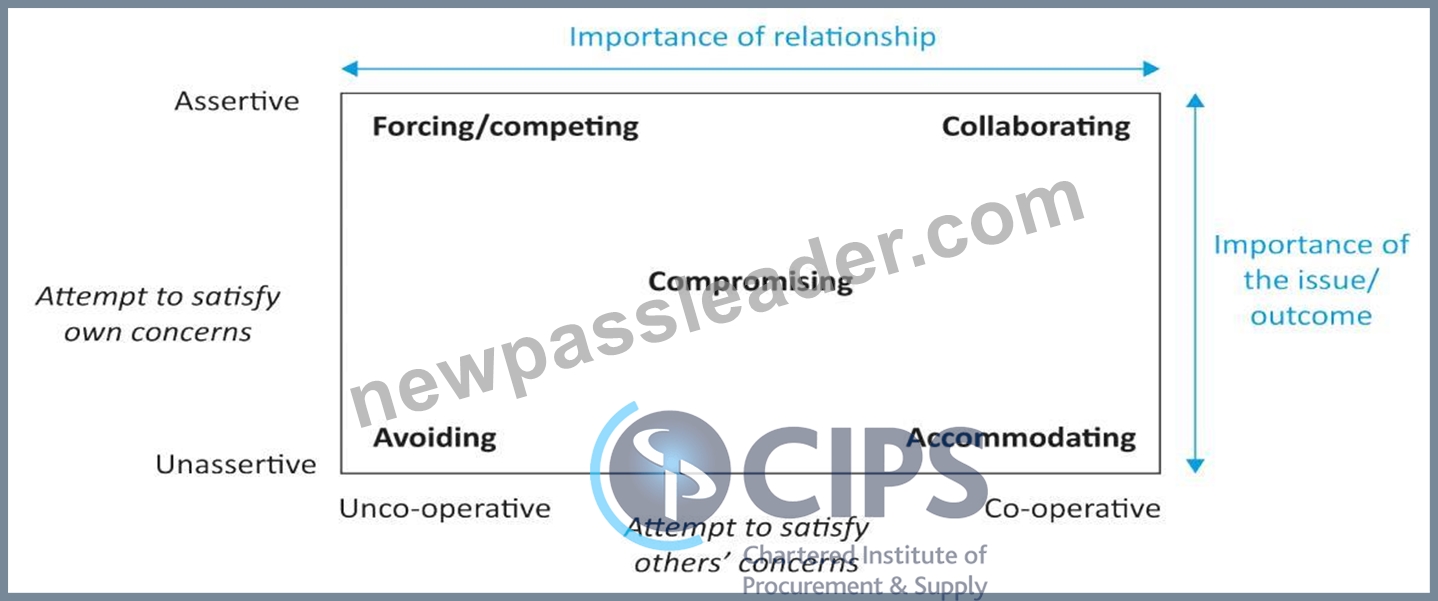
In this scenario, the buyer's bargaining power is stronger than suppliers', and the relationship is transactional.
Therefore, to get the most preferable outcome, the procurement professional can take an assertive approach, while he doesn't need to co-operate closely with these suppliers. Competing will be the most appropriate approach to negotiation in this scenario so that the buying organisation can get a better deal.
NEW QUESTION 89
Which of the following is the most appropriate approach to investors or shareholders who have high level of influence but low interest in the running of business?
- A. Engage and keep them satisfied
- B. Engage and consult with them regularly
- C. Manage them closely
- D. Keep these people inform through general communication media
Answer: A
Explanation:
Explanation
Investors or shareholders who have high level of influence but low interest belong to 'Keep satisfied' quadrant of Mendelow's Stakeholder Matrix.
You may read 2 versions from L4M1 and L4M5 here: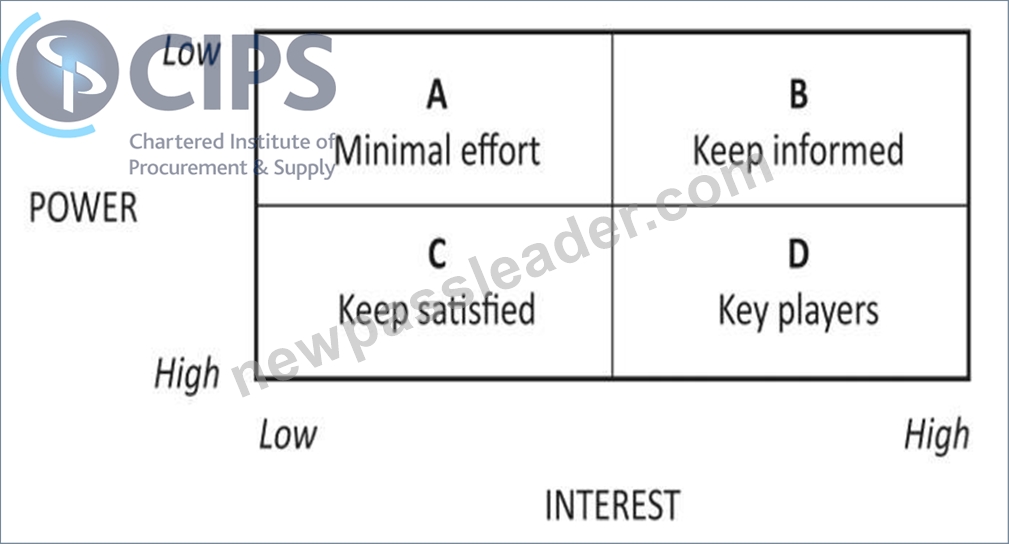
Table Description automatically generated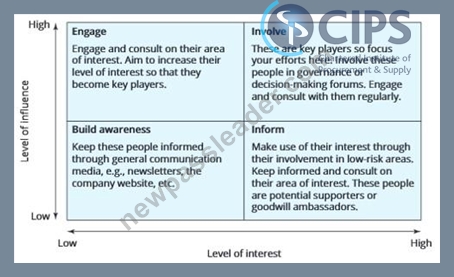
LO 1, AC 1.1
NEW QUESTION 90
All of the following shift the supply of watchesto the right except...?
- A. Manufacturers' expectation of higher watch prices in thefuture
- B. A decrease in the wage of workers employed to manufacture watches
- C. An increase in the price of watches
- D. An advance in the technology used to manufacture watches
Answer: C
Explanation:
Explanation
A supply curve will slope upward from left to right showing more supply at higher prices, as illustrated in the graph below:
A picture containing chart Description automatically generated
A movement along the supply curve will be brought about by a change in price, but a shift of the whole curve will be caused by a determinant other than price:
- The physical feasibility and time and energy required to produce the products
- Technology and innovation
- The objectives of the producers and their future expectations
- Prices of other goodsand services
- Government's policies
LO 2, AC 2.2
NEW QUESTION 91
Which of the following is considered a strength of a 'logical' style negotiator?
- A. Methodical
- B. Assertive
- C. Interrelate issues easily and make quick decisions
- D. Friendly and accessible
Answer: A
Explanation:
A useful and simple shorthand for preferrednegotiation styles is summarised by four simple descriptor: 'warm',
'tough', 'logical' and 'dealer', which can be applied to describe individuals' dominant preferred style in most circumstances.
Warm - a people person
Tough - a hard-nosed negotiator
Logic- a numbers person
Dealer - a trader who loves bargaining
Strengths, weaknesses of logical style are described below:
Table Description automatically generated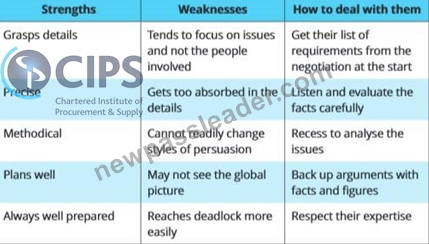
NEW QUESTION 92
Can a party gain huge advantages innegotiation from setting room layout?
- A. Yes, because the other party can capitulate to the host
- B. Yes, because the host can freely manipulate the other party's mind through setting room layout
- C. No, because the advantages gained from manipulating room layout are short-lived
- D. No, because room layout contributes nothing to the negotiation outcomes
Answer: C
Explanation:
Essentially, for trained negotiators under most circumstances, the physical locations of negotiations and the room layout should not make much difference to the outcomes of the meeting. It is reasonable to assume that most commercial negotiations are based at least initially on a principled- or pragmatic-type approach. It is arguable also that any advantage gained through intentionally creating an uncomfortable environment to put short-term pressure on TOP is likely to be short-lived as TOP will likely reflect on this later and seek means to get even.
NEW QUESTION 93
Collaborative approach in negotiation not only can fully satisfies the concerns of both, but also ensure that neither party will seek to be opportunistic in later time during the life of the contract. Is this statement true?
- A. No, because the parties will always find a compromise solution in integrative approach
- B. Yes, because all parties must have exactly the same goals in integrative negotiation
- C. No, because any party may leverage its own advantage during the contract
- D. Yes, because both parties have well understood each other's goals when they engage in collaborative negotiation
Answer: C
Explanation:
Integrative, interest-based negotiation can facilitate constructive, positive relationship and establish contracts between parties on a foundation of goodwill. It is important to note it can only facilitate these positive outcomes, it does not guarantee that the other party will not seek to be opportunistic at a later time during the life of the contract. Previous knowledge of the behaviours of the other party regarding honouring contractual and other commitments will be useful here in predicting long-term outcomes, not ensuring that they will not leverage their advantages.
NEW QUESTION 94
Which of the following is NOT a barrier to entry in amonopolized market?
- A. The costs of production make a single producer more efficient than a large number of producers
- B. A single firm is very large
- C. A key resource is owned by a single firm
- D. The government gives a single firm the exclusive right to produce some good
Answer: B
Explanation:
Monopolies exist in many markets in real life for very different reasons:
Ownership of a Key Resource: When one company exerts sole control over a resource that is necessary for the production of a specific product,the market may become a monopoly. For example, the only medication deemed acceptable to treat a disease comes from a particular ingredient X, and knowledge of this ingredient X is owned by a single family owned company. The company can, therefore, be saidto have a monopoly over ingredient X that is needed to cure the disease because it is the only company that can produce a product deemed acceptable.
Government Franchise: In certain instances, a monopoly may be explicitly created by the government if it grants a single company, whether private or government-owned, the right to conduct business in a particular market. For example, when a national railways transportation service is created by the government, in most cases they are granted a monopoly on the operation of passenger trains in the country. As a result, other firms are only able to offer passenger train services with the cooperation and/or permission of the government-owned provider.
Intellectual Property Protection: Extending intellectual propertyprotection to a company in the form of patents and copyrights is yet another way in which monopolies are created. When a government does this, it is in fact giving a single company an exclusive right to provide a particular product / service to the market. Patents and copyrights work in providing owners of intellectual property with the right to act as an exclusive provider of a new product for a specific length of time. This creates a temporary monopoly in the market with regards to new products and services.
Natural Monopoly: A market may also become a monopoly simply because it may be more cost-effective for one company to serve the whole market than to have several smaller firms in competition with one another. A company with virtually unlimited economies of scale is referred to as a natural monopoly. Such firms become monopolies due to their position and size, which makes it impossible for new entrants in the market to compete price-wise. Natural monopolies are common in industries with high fixed costsand low marginal costs of operation such as providers of television, telephone, and internet services.
In this question, 'A single firm is very large' is not enough to tell whether this market is monopolistic.
NEW QUESTION 95
Personal power is only used in distributive approach. Is this statement true?
- A. Yes, because only distributive approach to negotiation requires strong personal power
- B. No, because personal power can be veryhelpful in integrative approach
- C. Yes, because one party will abuse coercive power to maximise the gain
- D. No, because only organisational power will optimise the negotiation outcomes
Answer: B
Explanation:
Explanation
Power, or more precisely perceptions of power,are critically important in understanding the commercial negotiation process. From a commercial negotiation point of view (under any circumstances, either integrative or distributive approach), CIPS is interested in power from both a personal and organisational perspective.
When you are negotiating on behalf of your employer, you bring the power of your organisation (its brand, reputation and purchasing spend) as well your own personal power (6 sources of personal power, based on French and Raven's power base model) to the negotiation.
In both integrative and distributive approaches, personal power plays an important role. It helps both parties push through negotiating barriers and secure commitment and final agreement LO 1, AC 1.3
NEW QUESTION 96
Which of the following are most likely to be direct costs of a steel manufacturer? Select THREE that apply.
- A. Seniormanagement salary
- B. Cleaning services
- C. Scrap metal
- D. Coal
- E. Hourly production wages
- F. Insurance for production lines
Answer: C,D,E
Explanation:
Direct costs are those costs of a product/service directly attributable/traceable to its production. Examples of direct costsincluding the following:
Materials and services bought-in: In steel manufacturer, raw materials are iron ores, scrap metal, coals, etc Labour or wages: money paid to staff for the work involved in producing the product.
Other expenses: other charges incurred that can be specifically attributed to a particular product, batch or service
NEW QUESTION 97
It may be more difficult to buy on a credit from supplier who locates in a country with a hyperinflation? Is this assumption true?
- A. No, because the higher the inflation rate, the stronger the supplier's currency
- B. No, because supplier's bank will take risks from currency fluctuation
- C. Yes, because thesupplier's currency will lose its value overtime
- D. Yes, because buyer has more advantage if they make payment in their own currency
Answer: C
Explanation:
If theinflation rate is running high, then obtaining credit as a buyer is normally more difficult or expensive as money in the future will be worth less than money today.
NEW QUESTION 98
Which of the following types of questions should be used most often in the proposing phase?
- A. Closed questions
- B. Probing questions
- C. Open questions
- D. Hypothetical questions
Answer: D
Explanation:
Explanation
At the proposing phase either side may start making tentative proposals regarding their offering. In the case of negotiation where TOP has already submitted a tender or proposal, this stage may provide an opportunity for them to make proposals to improve on their initial offers in general or in areas highlighted by the buying side in advance.
The word 'if' is very useful at this stage andallows you to test tentative proposals without committing yourself.
Skilled negotiators use language very carefully. The questions with 'if' are hypothetical ones.
LO 3, AC 3.1
NEW QUESTION 99
A good negotiator invests time in understanding the needs of the individuals in a negotiation. Is this statement true?
- A. No, because satisfying individual needs will lead to conflict of interest and unethical practices
- B. Yes, because individuals' needs always unify with their own organisation's needs and wants
- C. Yes, because individual needs largely influence the outcomes of the negotiation
- D. No, becausenegotiator should attempt to satisfy the needs of the other organisation only
Answer: C
Explanation:
Skilled negotiators seek to understand the needs of the other parties, as well as their own. In doing so, it allows them to determine a strategy that their own needs are met. Failing to understand the other party's needs is one of the most common reason for an unsuccessful negotiation. In the commercial negotiation, procurement team does not negotiate with organisation, they negotiate with individuals. It is therefore important to recognise that there are two levels of needs:
The organisation - What the organisation wants to achieve. This is generally well stated and understood The individual - what is in it for the individual? This is generally not stated, rarely discussed, but very motivational. It is vitally important therefore that time is invested in understanding the needs of the individual Skilled negotiators are aware of the needs that occur at both levels, and develop creative options and strategies that attempt to satisfy these needs.
NEW QUESTION 100
To buying organisation, savings can be achieved from different saving levers or tactics. Which of the following are means that deliver savings through optimising specifications?
- A. Part substitution
- B. Compare total cost of ownership
- C. Value engineering
- D. Budgetlinkages
- E. Volume pooling
Answer: A,C
Explanation:
If driving greater value and efficiency from your supply base is your end, you should remember that there are many ways to do this without seeking to negotiate lowerprices. Below are 7 types of saving levers:
Table Description automatically generated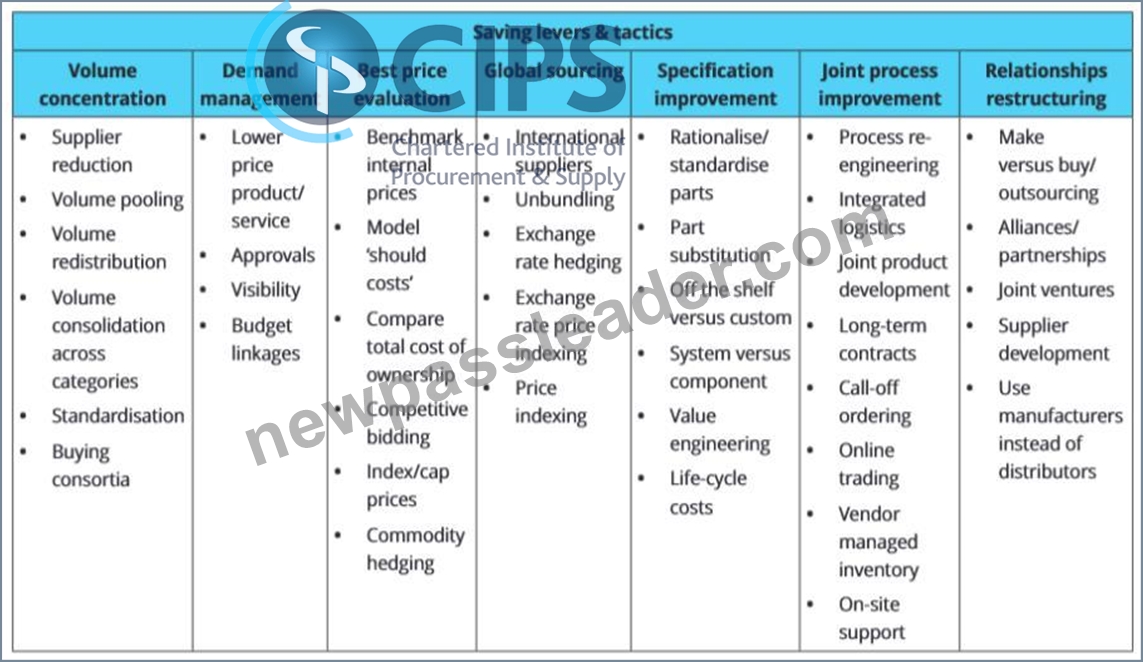
NEW QUESTION 101
Which of thefollowing are signs indicating that TOP is using coercive power in commercial negotiation?
Select TWO that apply.
- A. Technical expertise
- B. Positive references
- C. Use of guilt
- D. Demonstrating fairness and respect
- E. Withdrawal of benefits
Answer: C,E
Explanation:
Coercive power comes from the belief that a person can punish other for non-compliance, and can be considered as the flip side of reward power. Coercive power rests in the individual's ability to change other people's behaviour through threat,intimidation, use of guilt, ability to embarrass or shame, or withdrawal of benefits,...
NEW QUESTION 102
Which of the following is the true statement?
- A. Internal stakeholder support will be important for both negotiation and contract performance
- B. All connected stakeholders have a low level of impact on procurement negotiations
- C. Commercial negotiation objectives should be driven by just the instincts of procurement
- D. External stakeholders such as suppliers can largely influence an organisation's procurement negotiations
Answer: A
Explanation:
Internal stakeholder support will be important not just at the initial negotiation of the contract, but potentially throughout the life of the contract right through to exit.
As a general rule, connected stakeholders (with the exception of suppliers) have a low level of influence on procurement negotiations.
Suppliers are connected stakeholders who have contractual relationships with the organisation.
Commercial negotiation objective should be driven by thebusiness needs of the organisation, and not just the instinct of procurement.
NEW QUESTION 103
......
Latest L4M5 Exam Dumps CIPS Exam: https://www.newpassleader.com/CIPS/L4M5-exam-preparation-materials.html
Pass CIPS L4M5 PDF Dumps Recently Updated 165 Questions: https://drive.google.com/open?id=1ikYibvYtruM3SGZi9O2nO60PYrNpIpga