

AD0-E134 Practice Dumps - Verified By NewPassLeader Updated 52 Questions
Updated AD0-E134 Exam Dumps - PDF Questions and Testing Engine
NEW QUESTION # 15
An AEM application development team is assigned a task to create an Event-Driven Data Layer implementation for an Analytics solution.
Which Adobe recommended best practice should the developer choose?
- A. Use Adobe Experience Platform's data layer to integrate with AEM.
- B. Create an Adobe Cloud Service configuration to use third-party tool's data layer.
- C. Use Adobe Client Data Layer and integrate with Core components.
- D. Create a custom data layer and add each component template, and its properties to the data layer
Answer: C
Explanation:
Explanation
Adobe Client Data Layer is a JavaScript library that provides a standardized way to collect, structure, and manage data on a web page. It can be used to implement an event-driven data layer for analytics solutions. It integrates with Core components and allows authors to configure data layer properties for each component. It also supports custom events and data sources. References:
https://experienceleague.adobe.com/docs/experience-manager-core-components/using/developing/data-layer.htm
NEW QUESTION # 16
An application development team needs to create a multi-channel application that uses AEM as a headless CMS Which feature should be used to maintain structured data for this application?
- A. Static template
- B. Content fragment
- C. Experience fragment
- D. Custom component
Answer: B
Explanation:
Explanation
A content fragment is a reusable piece of content that can be authored and managed independently from a page. Content fragments are based on structured data models that define the elements and data types of the content. Content fragments can be delivered as JSON using various APIs, such as Assets HTTP API, Content Fragments REST API, or Content Fragments GraphQL API. Content fragments are suitable for creating multi-channel applications that use AEM as a headless CMS. References:
https://experienceleague.adobe.com/docs/experience-manager-learn/foundation/headless/introduction-to-headles
NEW QUESTION # 17
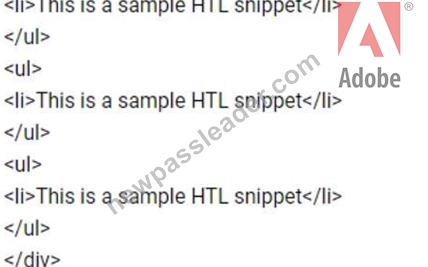
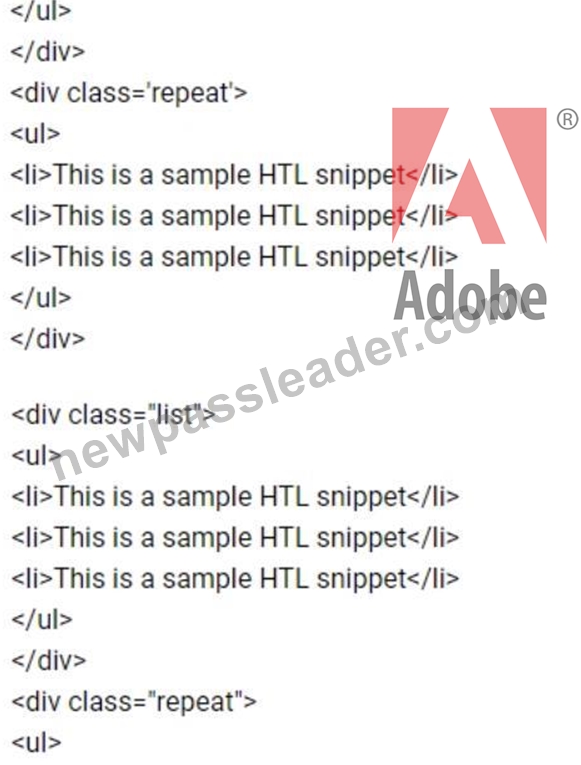
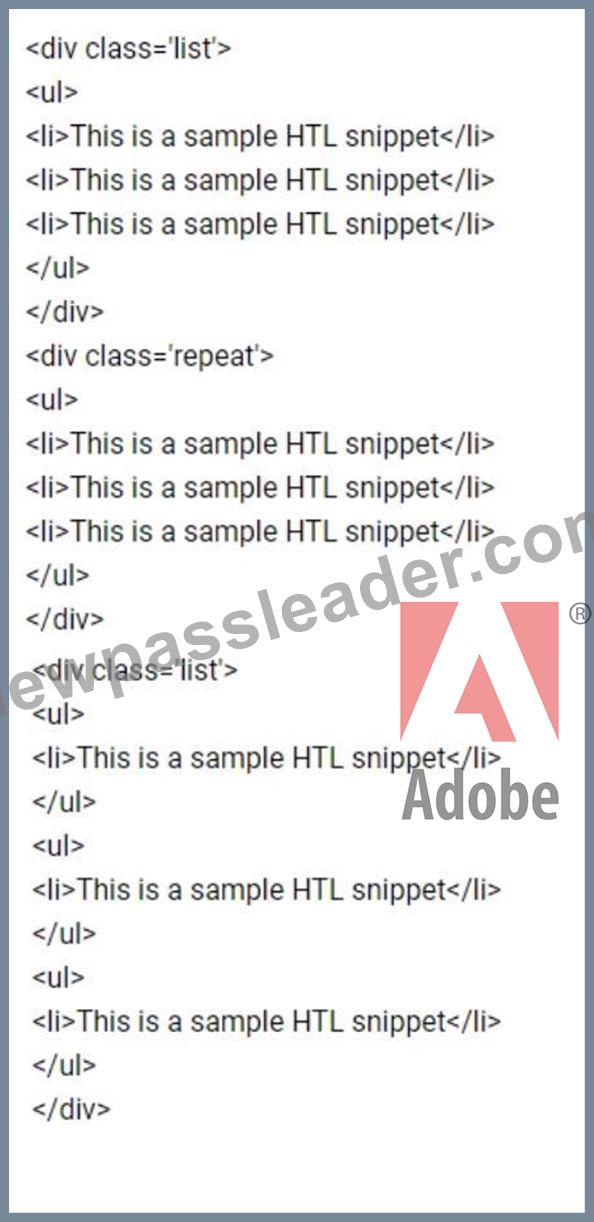
Refer to the exhibit.
The current page has three children.
What is the final rendered html output for the code snippet?
- A.
- B.
- C.
Answer: B
Explanation:
Explanation
Option B is the final rendered html output for the code snippet. The code snippet uses the data-sly-list block statement to iterate over the child pages of the current page. The data-sly-list statement assigns each child page to a variable named page and provides an index variable named i. The code snippet then uses the data-sly-test block statement to check if the index is odd or even and applies a different CSS class accordingly. The code snippet also uses the data-sly-element block statement to create an HTML element with the name specified by the elementName variable. The code snippet also uses the data-sly-attribute block statement to add an attribute with the name specified by the attrName variable and the value specified by the attrValue variable. The code snippet also uses the data-sly-resource block statement to include a resource with the path specified by the page.path variable and the resourceType specified by the resourceType variable.
References:https://experienceleague.adobe.com/docs/experience-manager-htl/using-htl/htl-block-statements.htm
NEW QUESTION # 18
An AEM Developer needs to migrate to AEM as a Cloud Service from AEM version 6.4. The AEM Developer is not able to run the Best Practice Analyzer.
What is preventing the Best Practice Analyzer from running?
- A. Best Practice Analyzer is not supported on AEM version 6.4.
- B. Best Practice Analyzer should run on Publisher instead of Author instance.
- C. The AEM Developer is not an admin or does not have administrator rights.
Answer: A
Explanation:
Explanation
The Best Practice Analyzer is a tool that scans an existing AEM code base and identifies patterns that are incompatible with AEM as a Cloud Service or newer versions of AEM on-premise. The Best Practice Analyzer is not supported on AEM version 6.4 or earlier versions. The Best Practice Analyzer requires AEM version 6.5 or later to run. References:
https://experienceleague.adobe.com/docs/experience-manager-cloud-service/moving/cloud-migration/best-practi
https://experienceleague.adobe.com/docs/experience-manager-cloud-service/moving/cloud-migration/best-practi
NEW QUESTION # 19
The following anchor tag is not resolving:
<a href="item.path" >{item.name}</a>
Upon further inspection the developer notices that the link has no .html appended to the end of the URL What could be a potential fix for the issue?
- A.

- B.

- C.

- D.

Answer: B
Explanation:
Explanation
Option B is a potential fix for the issue. Option B uses the data-sly-attribute block statement to add the href attribute to the anchor tag. The data-sly-attribute statement uses an expression to append ".html" to the item.path value. This way, the link will have the correct extension and will resolve to the corresponding page.
References:https://experienceleague.adobe.com/docs/experience-manager-htl/using-htl/htl-block-statements.htm
NEW QUESTION # 20
An AEM application wants to set up multi-tenancy using Adobe-recommended best practices and bind multiple configurations to it. Which of the following options is recommended?
- A. import org.osgi.service.component.annotations.Component; @Component(service = ConfigurationFactory.class)
- B. import org.apache.felix.scr.annotations.Component; @Component(label = "My configuration", metatype = true, factory= true)
- C. import org.osgi.service.metatype.annotations.AttributeDefinition;
import org.osgi.service.metatype.annotations.ObjectClassDefinition;
@ObjectClassDefinition(name = "My configuration") - D. @Component(service = ConfigurationFactory.class)
@Designate(ocd = ConfigurationFactorylmpl.Config.class, factory=true)
Answer: D
Explanation:
Explanation
The @Component(service = ConfigurationFactory.class) @Designate(ocd =
ConfigurationFactorylmpl.Config.class,factory=true) option is recommended for creating a multi-tenancy configuration and binding multiple configurations to it. This option uses the OSGi R6 annotations to define a component that provides a service of type ConfigurationFactory and designates a class that contains the configuration properties. The factory=true attribute indicates that multiple configurations can be created for this component.
References:https://experienceleague.adobe.com/docs/experience-manager-65/deploying/configuring/osgi-configu
NEW QUESTION # 21
An AEM server is overloaded with too many concurrently running workflows. The developer decides to reduce the number of concurrent workflows.
What should be configured to reduce the number of concurrent workflows?
- A. Maximum Parallel Jobs in OSGI console
- B. The number of threads in Apache Felix Jetty Http Service
- C. The number of threads in Scheduler
- D. Launchers for each workflow
Answer: A
Explanation:
Explanation
Maximum Parallel Jobs is a configuration property that controls how many workflows can run concurrently on an AEM instance. Reducing this value can help to avoid overloading the server with too many workflows.
NEW QUESTION # 22
Which tool should a developer use to look up Adobe Identity Management System (IMS) users by email and return their IMS IDs?
- A. User Mapping Tool
- B. IMS Lookup Tool
- C. Cloud Acceleration
- D. Developer Console
Answer: B
Explanation:
Explanation
The IMS Lookup Tool is a tool that allows looking up Adobe Identity Management System (IMS) users by email and returning their IMS IDs. The IMS Lookup Tool is available in the Cloud Manager UI under the Tools menu. The IMS Lookup Tool can be used to find the IMS IDs of users who need to be added to Cloud Manager programs or environments. References:
https://experienceleague.adobe.com/docs/experience-manager-cloud-service/implementing/using-cloud-manager
NEW QUESTION # 23
Which type of Cloud Manager tests are enabled for all Cloud Manager production pipelines and cannot be skipped?
- A. Ul Testing
- B. Experience Audit Testing
- C. Functional Testing
- D. Code Quality Testing
Answer: D
Explanation:
Explanation
Code Quality Testing is a type of Cloud Manager tests that are enabled for all Cloud Manager production pipelines and cannot be skipped. Code Quality Testing checks the code quality of the project using SonarQube and reports any issues or vulnerabilities. Code Quality Testing can fail the pipeline if the code quality does not meet the minimum standards defined by Adobe. References:
https://experienceleague.adobe.com/docs/experience-manager-cloud-service/implementing/testing/testing-overvi
NEW QUESTION # 24
An AEM application requires LDAP Service integration to synchronize users/groups. Which two OSGi configuration are required for LDAP integration in AEM? (Select Two.)
- A. Apache Jackrabbit Oak CUG Configuration
- B. Apache Jackrabbit Oak External Login Module
- C. Apache Jackrabbit Oak Default Sync Handler
- D. Apache Jackrabbit Oak Solr server provider
- E. Apache Jackrabbit Oak AuthorizableActionProvider
Answer: B,C
Explanation:
Explanation
The Apache Jackrabbit Oak External Login Module and Apache Jackrabbit Oak Default Sync Handler are the two OSGi configurations that are required for LDAP integration in AEM. The External Login Module defines how AEM connects to the LDAP server and authenticates users against it. The Default Sync Handler defines how AEM synchronizes users and groups from the LDAP server to the repository.
References:https://experienceleague.adobe.com/docs/experience-manager-65/administering/security/ldap-config.
NEW QUESTION # 25
An AEM Developer needs to create a new component to help support a new product launch.
* The client is on AEM 6.5 on-premise with the latest version of WCM Core Components
* The component must include text, image, and a link
* The component must support multiple designs
Which process should the AEM Developer use to support the launch?
- A. 1. Extend the Text Component from Core Components
2. Enable image manipulations for the Text Component via policy - B. 1. Create a new component by extending the Text Component from Core Components
2. Add dialog properties and modify HTL to support images - C. 1. Extend the Teaser Component from Core Components
2. Create style variations to be used in the Style System - D. 1. Create a new Image with Text component that exposes the Core Components authoring dialogs for those components
2. Add a policy to define which designs are used
Answer: C
Explanation:
* Extend the Teaser Component from Core Components
* Create style variations to be used in the Style System** Comprehensive Explanation of Correct Answer Only: The Teaser Component from Core Components is a component that allows authors to display a title, description, image and link for a teaser item. The component supports multiple designs and can be extended to add custom features or logic. The Style System allows authors to define style variations for components without requiring code changes or new templates. References:
https://experienceleague.adobe.com/docs/experience-manager-core-components/using/components/teaser.h
https://experienceleague.adobe.com/docs/experience-manager-core-components/using/components/style-sy
NEW QUESTION # 26
A developer needs to create sling models for two fields name and occupations. The dialog has two fields, name - a single value field, and occupations - a multi value field.
The following code is included in sling models inherited from interface com.adobe.aem.guides.wknd.core.models.Byline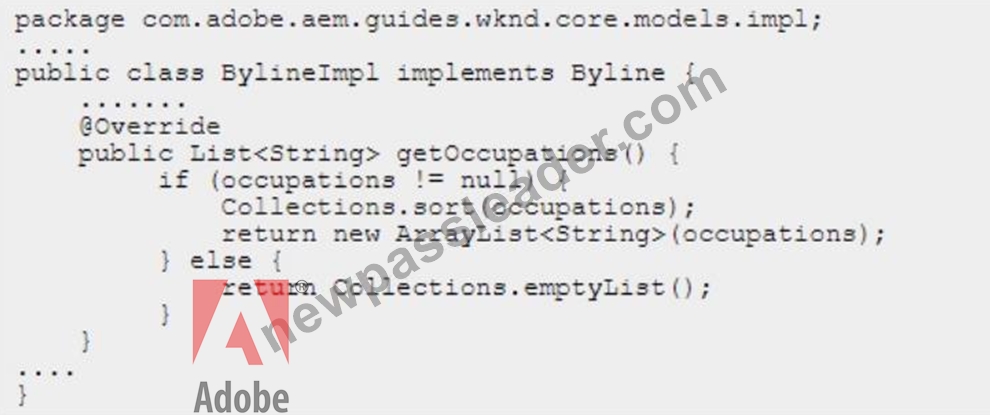
- A.

- B.

- C.

- D.

Answer: C
Explanation:
Explanation
Option C is the correct implementation for the Sling Model. Option C uses the @Model annotation with the adaptables parameter set to Resource.class. This allows the Sling Model to adapt from a resource object and access its properties using the ValueMap interface. Option C also uses the @Inject annotation with the name parameter set to "./name" and "./occupations" to inject the values of the name and occupations properties into the name and occupations fields. Option C also uses the @Named annotation with the value parameter set to
"byline" to specify the name of the Sling Model that can be used in HTL scripts. References:
https://sling.apache.org/documentation/bundles/models.htmlhttps://experienceleague.adobe.com/docs/experience
NEW QUESTION # 27
An AEM application requires LDAP Service integration to synchronize users/groups. Which two OSGi configuration are required for LDAP integration in AEM? (Select Two.)
- A. Apache Jackrabbit Oak CUG Configuration
- B. Apache Jackrabbit Oak External Login Module
- C. Apache Jackrabbit Oak Default Sync Handler
- D. Apache Jackrabbit Oak Solr server provider
- E. Apache Jackrabbit Oak AuthorizableActionProvider
Answer: B,C
Explanation:
Explanation
The Apache Jackrabbit Oak External Login Module and Apache Jackrabbit Oak Default Sync Handler are the two OSGi configurations that are required for LDAP integration in AEM. The External Login Module defines how AEM connects to the LDAP server and authenticates users against it. The Default Sync Handler defines how AEM synchronizes users and groups from the LDAP server to the repository.
References:https://experienceleague.adobe.com/docs/experience-manager-65/administering/security/ldap-config.
NEW QUESTION # 28
What is the recommended path to override /libs standard functionality?
- A. /content
- B. /Iibs
- C. /conf
- D. /apps
Answer: D
Explanation:
Explanation
The recommended path to override /libs standard functionality is /apps. The /apps folder contains application-specific code and configuration that can extend or override the default functionality provided by
/libs. The /apps folder has precedence over the /libs folder, meaning that if there are two resources with the same path under both folders, the one under /apps will be used. References:
https://experienceleague.adobe.com/docs/experience-manager-cloud-service/implementing/developing/aem-proje
NEW QUESTION # 29
A developer needs to create a runmode-specific OSGi configuration for an AEM as a Cloud Service implementation. In which location should the OSGi configuration be created?
- A. ui.apps project (/apps/.../config.<runmode>) folder
- B. ui.config project, (/config/.../config.<runmode>) folder
- C. core project, (/core/.../config <runmode>) folder
- D. all project, (/all/.../config.<runmode>) folder
Answer: B
Explanation:
Explanation
The ui.config project, (/config/.../config.<runmode>) folder is the location where the OSGi configuration should be created for a runmode-specific configuration for an AEM as a Cloud Service implementation. The ui.config project contains OSGi configurations that are deployed to /apps in the repository. The config.<runmode> folder specifies the runmode for which the configuration is applicable, such as author or publish.
References:https://experienceleague.adobe.com/docs/experience-manager-cloud-service/implementing/deploying
NEW QUESTION # 30
A client is having issues with some query results:
* Many of the client's industry terms have the same meaning, and users do not always search the exact wording
* Many users search by typing in short phrases instead of exact keywords, ex:// "cats and dogs" What index analyzers should the AEM developer recommend?
- A. 1. Tokenize the current indexes with a Keyword tokenizer
2. Add a Mapping filter to the current indexes - B. 1. Add a Synonym filter to the current indexes
2. Add a Stop filter to the current indexes - C. 1. Add a Mapping filter to the current indexes
2. Add a Stop filter to the current indexes - D. 1. Add a Synonym filter to the current indexes
2. Add a LowerCase filter to the current indexes
Answer: D
Explanation:
Explanation
A Synonym filter can help to map different terms that have the same meaning, such as "cat" and "feline". A LowerCase filter can help to normalize the case of the terms, so that "cats and dogs" and "Cats and Dogs" are treated the same.
NEW QUESTION # 31
......
New (2023) Adobe AD0-E134 Exam Dumps: https://www.newpassleader.com/Adobe/AD0-E134-exam-preparation-materials.html
Best Way To Study For Adobe AD0-E134 Exam Brilliant AD0-E134 Exam Questions PDF: https://drive.google.com/open?id=1ejVb8SybzIaiDrpaztgk857WfIINhuHl