

[Oct-2025] Exam L6M2: New Brain Dump Professional - NewPassLeader
Free L6M2 Exam Dumps to Improve Exam Score
NEW QUESTION # 11
SIMULATION
XYZ is a toilet paper manufacturer based in the UK. It has 2 large factories employing over 500 staff and a complex supply chain sourcing paper from different forests around the world. XYZ is making some strategic changes to the way it operates including changes to staffing structure and introducing more automation. Discuss 4 causes of resistance to change that staff at XYZ may experience and examine how the CEO of XYZ can successfully manage this resistance to change
Answer:
Explanation:
Causes of Resistance to Change & Strategies to Manage It - XYZ Case Study When XYZ, a UK-based toilet paper manufacturer, implements strategic changes such as staff restructuring and automation, employees may resist change due to uncertainty, fear, and disruption to their work environment. Below are four key causes of resistance and how the CEO can manage them effectively.
Causes of Resistance to Change
1. Fear of Job Loss
Cause: Employees may fear that automation will replace their jobs, leading to layoffs. Factory workers and administrative staff may feel particularly vulnerable.
Example: If machines take over manual processes like paper cutting and packaging, employees may see this as a direct threat to their roles.
2. Lack of Communication and Transparency
Cause: When management fails to communicate the reasons for change, employees may speculate and assume the worst. Unclear messages lead to distrust.
Example: If XYZ's CEO announces restructuring without explaining why and how jobs will be affected, employees may feel insecure and disengaged.
3. Loss of Skills and Status
Cause: Some employees, especially long-serving workers, may feel their skills are becoming obsolete due to automation. Managers may resist change if they fear losing power in a new structure.
Example: A production line supervisor may oppose automation because it reduces the need for human oversight, making their role seem redundant.
4. Organizational Culture and Habit
Cause: Employees are accustomed to specific ways of working, and sudden changes disrupt routine. Resistance occurs when changes challenge existing work culture.
Example: XYZ's employees may have always used manual processes, and shifting to AI-driven production feels unfamiliar and uncomfortable.
How the CEO Can Manage Resistance to Change
1. Effective Communication Strategy
✅ What to do?
Clearly explain why the changes are necessary (e.g., cost efficiency, competitiveness).
Use town hall meetings, emails, and team discussions to provide updates.
Address employee concerns directly to reduce uncertainty.
Example: The CEO can send monthly updates on automation, ensuring transparency and reducing fear.
2. Employee Involvement and Engagement
✅ What to do?
Involve staff in decision-making to give them a sense of control.
Create cross-functional teams to gather employee input.
Provide opportunities for feedback and discussion.
Example: XYZ can form a worker's advisory panel to gather employee concerns and address them proactively.
3. Training and Upskilling Programs
✅ What to do?
Offer training programs to help employees adapt to new technologies.
Provide reskilling opportunities for employees whose jobs are affected.
Reassure staff that automation will create new roles, not just eliminate jobs.
Example: XYZ can introduce digital skills training for workers transitioning from manual processes to automated systems.
4. Change Champions & Support Systems
✅ What to do?
Appoint change champions (influential employees) to advocate for change.
Offer emotional and psychological support (e.g., HR consultations, career guidance).
Recognize and reward employees who embrace change.
Example: XYZ can offer bonuses or promotions to employees who successfully transition into new roles.
Conclusion
Resistance to change is natural, but the CEO of XYZ can minimize resistance through clear communication, employee involvement, training, and structured support. By managing resistance effectively, XYZ can ensure a smooth transition while maintaining employee morale and operational efficiency.
NEW QUESTION # 12
SIMULATION
Evaluate diversification as a growth strategy. What are the main drivers and risks?
Answer:
Explanation:
Evaluation of Diversification as a Growth Strategy
Introduction
Diversification is a growth strategy where a company expands into new markets or develops new products that are different from its existing offerings. It is the riskiest strategy in Ansoff's Growth Matrix, but it can provide significant opportunities for business expansion, revenue diversification, and risk mitigation.
Diversification is driven by factors such as market saturation, competitive pressure, and technological advancements but also carries risks related to high investment costs and operational complexity.
1. Types of Diversification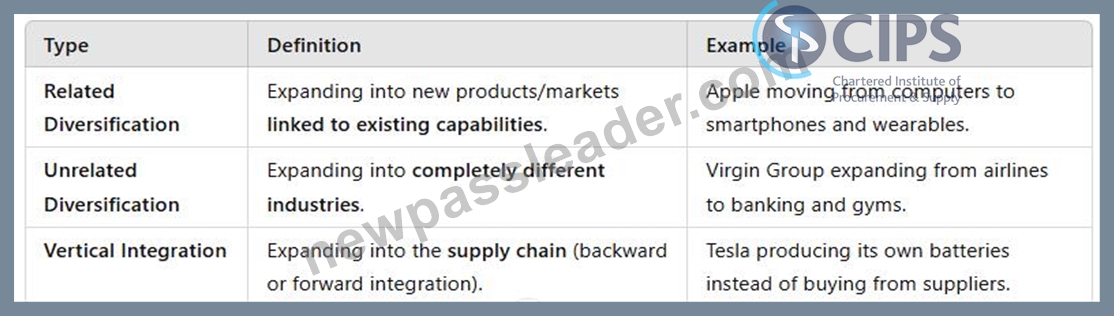
2. Main Drivers of Diversification
1. Market Saturation and Competitive Pressure
When a business reaches peak growth in its existing market, diversification helps find new revenue streams.
Competition forces businesses to explore new industries for continued growth.
Example: Amazon expanded from an online bookstore to cloud computing (AWS) due to competition and limited retail growth.
2. Risk Reduction and Business Sustainability
Diversifying reduces dependence on a single market or product.
Protects the business against economic downturns and industry-specific risks.
Example: Samsung operates in electronics, shipbuilding, and insurance, reducing reliance on one sector.
3. Leveraging Core Competencies and Brand Strength
Companies use existing expertise, technology, or brand reputation to enter new markets.
Example: Nike expanded from sportswear to fitness apps and wearable technology.
4. Technological Advancements & Market Opportunities
Digital transformation and innovation create opportunities for diversification.
Companies invest in new technologies, AI, and automation to expand their offerings.
Example: Google diversified into AI, smart home devices, and autonomous vehicles (Waymo).
3. Risks of Diversification
1. High Investment Costs & Uncertain Returns
Diversification requires significant R&D, marketing, and infrastructure investment.
ROI is uncertain, and failure can result in financial losses.
Example: Coca-Cola's failed diversification into the wine industry resulted in losses due to brand mismatch.
2. Lack of Expertise & Operational Challenges
Expanding into unfamiliar industries increases operational complexity and risks.
Companies may lack the expertise required for success.
Example: Tesco's expansion into the US market (Fresh & Easy) failed due to a lack of understanding of American consumer behavior.
3. Dilution of Brand Identity
Expanding into unrelated sectors can confuse customers and weaken brand strength.
Example: Harley-Davidson's attempt to enter the perfume market damaged its brand credibility.
4. Regulatory and Legal Barriers
Compliance with different industry regulations can be complex and costly.
Example: Facebook faced regulatory scrutiny when diversifying into financial services with Libra cryptocurrency.
4. Conclusion
Diversification can be a high-reward growth strategy, but it requires careful planning, market research, and strategic alignment.
✅ Main drivers include market saturation, risk reduction, leveraging expertise, and technology opportunities.
❌ Key risks include high costs, operational challenges, brand dilution, and regulatory barriers.
Companies must evaluate diversification carefully and ensure strategic fit, financial feasibility, and market demand before expanding into new industries.
NEW QUESTION # 13
SIMULATION
Discuss how XYZ, a global beverage manufacturing organisation, could use the Boston Consultancy Group Framework to impact upon strategic decision making Introduction The Boston Consulting Group (BCG) Matrix is a strategic tool used by organizations to analyze their product portfolio and allocate resources effectively. It classifies products into four categories-Stars, Cash Cows, Question Marks, and Dogs-based on market growth rate and market share.
As a global beverage manufacturing organization, XYZ can use the BCG Matrix to evaluate its product range, identify growth opportunities, and make informed strategic decisions.
1. Explanation of the BCG Matrix
The BCG Matrix is divided into four quadrants:
Example for XYZ:
Star: A fast-growing energy drink brand in emerging markets.
Cash Cow: A flagship cola product with stable market demand.
Question Mark: A new functional health drink with uncertain market acceptance.
Dog: An underperforming diet soda variant with declining sales.
2. How XYZ Can Use the BCG Matrix for Strategic Decision-Making
XYZ can use the BCG Matrix to make resource allocation and investment decisions based on product performance.
3. Advantages of Using the BCG Matrix for XYZ
✅ Resource Allocation - Helps prioritize investment in high-growth products.
✅ Strategic Focus - Identifies which products to grow, maintain, or phase out.
✅ Market Adaptation - Helps XYZ adjust its beverage portfolio based on changing consumer trends.
Example: If XYZ's energy drink (a Star) is experiencing high growth, more marketing and production investment may be justified.
4. Limitations of the BCG Matrix
❌ Ignores Market Competition - A product may have a high market share, but competition could still impact profitability.
❌ Simplistic Assumptions - Not all products neatly fit into one category; market dynamics are complex.
❌ Focuses on Growth and Share Only - It does not consider external factors like profit margins, customer loyalty, or brand strength.
Example: A Question Mark product might have potential, but if consumer preferences shift, it may never become a Star.
5. Application of the BCG Matrix in the Beverage Industry
XYZ can apply the BCG Matrix by reviewing its entire product portfolio across different geographic markets.
Conclusion
The BCG Matrix is a valuable strategic tool for XYZ to analyze its product portfolio, prioritize investments, and make informed market-based decisions. However, it should be used alongside other strategic models (e.g., PESTLE, VRIO) to ensure a comprehensive business strategy.
Answer:
Explanation:
Boston Consulting Group (BCG) Matrix and Strategic Decision-Making for XYZ
NEW QUESTION # 14
SIMULATION
Compare and contrast an aggressive and conservative approach to business funding.
Answer:
Explanation:
Comparison of Aggressive vs. Conservative Business Funding Approaches
Introduction
Businesses adopt different funding strategies based on their risk tolerance, growth objectives, and financial stability. Two contrasting approaches to business funding are:
Aggressive Funding Approach - Focuses on high-risk, high-reward strategies with more debt and short-term financing to fuel rapid expansion.
Conservative Funding Approach - Emphasizes financial stability, risk aversion, and long-term security, often relying on equity and retained earnings to fund operations.
Each approach has advantages and risks, influencing a company's liquidity, cost of capital, and financial sustainability.
1. Aggressive Business Funding Approach (High Risk, High Reward)
Definition
An aggressive funding strategy involves maximizing short-term debt, high leverage, and minimal cash reserves to accelerate growth and expansion.
✅ Key Characteristics:
Relies heavily on debt financing (bank loans, corporate bonds, short-term credit).
Prioritizes rapid growth and high returns over financial security.
Uses minimal equity financing to avoid ownership dilution.
Maintains low cash reserves, assuming cash flows will cover liabilities.
Example:
Startups and tech firms (e.g., Tesla, Uber, Amazon in early years) often borrow aggressively to scale rapidly.
Private equity firms fund acquisitions using high leverage to maximize returns.
Advantages of Aggressive Funding
✔ Faster business expansion - Capital is readily available for investments.
✔ Higher return potential - More funds are allocated to revenue-generating activities.
✔ Lower equity dilution - Existing shareholders maintain control as funding is primarily debt-based.
Disadvantages of Aggressive Funding
❌ High financial risk - Heavy debt increases vulnerability to economic downturns.
❌ Liquidity problems - Low cash reserves can cause issues during slow revenue periods.
❌ Higher borrowing costs - Lenders charge higher interest due to the risk involved.
Best for: Fast-growing companies, high-risk industries, and businesses with predictable cash flows.
2. Conservative Business Funding Approach (Low Risk, Long-Term Stability) Definition A conservative funding strategy focuses on low debt levels, high liquidity, and long-term financing to ensure financial stability and steady growth.
✅ Key Characteristics:
Uses retained earnings and equity financing over debt.
Minimizes reliance on short-term credit to avoid financial pressure.
Maintains high cash reserves for financial security.
Focuses on steady, sustainable growth rather than rapid expansion.
Example:
Berkshire Hathaway (Warren Buffett's company) follows a conservative funding model, relying on retained earnings rather than excessive debt.
Family-owned businesses often prioritize financial stability over rapid expansion.
Advantages of Conservative Funding
✔ Lower financial risk - Reduces dependence on external creditors.
✔ Stable cash flow - Ensures business continuity during economic downturns.
✔ Better credit rating - Stronger financial health allows for lower borrowing costs if needed.
Disadvantages of Conservative Funding
❌ Slower business growth - Limited access to capital can restrict expansion.
❌ Missed market opportunities - Competitors with aggressive funding may outpace the company.
❌ Higher cost of capital - Equity financing (selling shares) dilutes ownership and reduces profit per share.
Best for: Established businesses, risk-averse industries, and companies focusing on long-term sustainability.
3. Comparison Table: Aggressive vs. Conservative Funding Approaches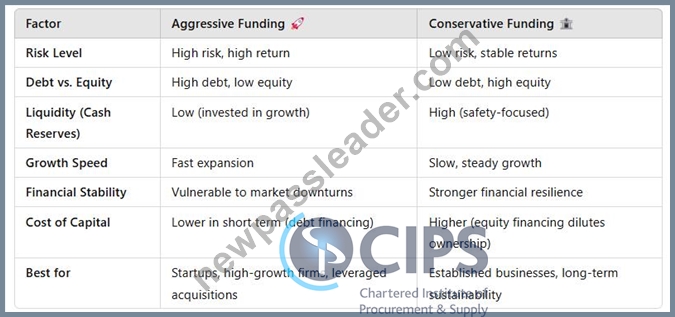
Key Takeaway: The best funding approach depends on industry, company stage, and risk appetite.
4. Which Approach Should a Business Use?
✅ Aggressive Approach is Ideal For:
Startups & High-Growth Companies - Need fast capital to capture market share.
Businesses in Competitive Markets - Companies that must outpace rivals through aggressive expansion.
Private Equity & Leveraged Buyouts - Maximizing returns through high debt strategies.
✅ Conservative Approach is Ideal For:
Mature & Stable Businesses - Companies prioritizing steady revenue and financial security.
Family-Owned Enterprises - Owners prefer low debt and long-term growth.
Risk-Averse Industries - Businesses in essential goods/services sectors where stability is more important than rapid expansion.
Hybrid Approach: The Best of Both Worlds?
Many businesses use a combination of both approaches, leveraging debt for growth while maintaining financial stability through retained earnings and equity.
Example:
Apple used a conservative strategy in its early years but adopted aggressive funding for global expansion post-2010.
5. Conclusion
The choice between aggressive and conservative funding depends on a company's growth goals, financial risk tolerance, and industry conditions.
✅ Aggressive funding maximizes short-term growth but increases financial risk.
✅ Conservative funding ensures stability but limits expansion speed.
✅ Most companies use a hybrid model to balance growth and financial security.
Understanding these approaches helps businesses optimize capital structure, manage risk, and align financing with strategic objectives.
NEW QUESTION # 15
SIMULATION
Discuss the role and influence of industry regulators and international bodies in the business environment.
Answer:
Explanation:
The Role and Influence of Industry Regulators and International Bodies in the Business Environment Introduction Industry regulators and international bodies play a critical role in shaping the business environment by enforcing regulations, setting industry standards, and ensuring fair competition. These organizations influence how businesses operate, impacting areas such as trade, finance, environmental sustainability, labor practices, and consumer protection.
Companies must comply with regulations set by both domestic industry regulators and global institutions to maintain legal and ethical business operations.
1. Role of Industry Regulators
Industry regulators are government-appointed or independent organizations that oversee specific sectors to ensure compliance with laws and standards. Their key functions include:
✅ Enforcing Compliance - Ensuring companies adhere to legal requirements (e.g., financial reporting, safety regulations).
✅ Promoting Fair Competition - Preventing monopolies and anti-competitive practices.
✅ Consumer Protection - Safeguarding consumer rights and ensuring product/service quality.
✅ Regulating Market Entry and Operations - Setting standards for licensing, pricing, and ethical conduct.
Example of Industry Regulators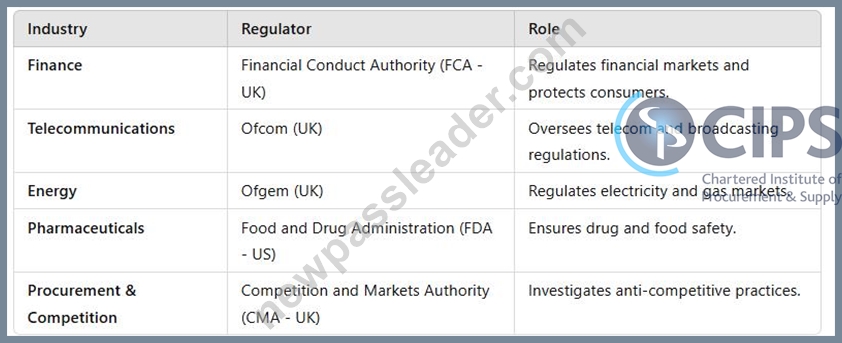
Case Example: The UK's Competition and Markets Authority (CMA) blocked Microsoft's acquisition of Activision Blizzard due to concerns over market dominance in cloud gaming.
2. Role of International Bodies
International bodies set global regulations, trade policies, and ethical standards that influence businesses operating across borders.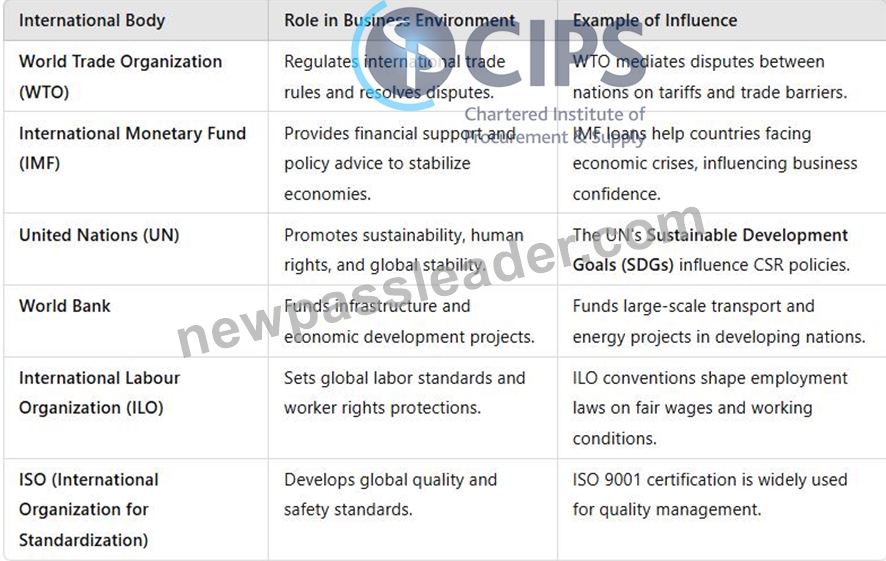
Case Example: The WTO's intervention in Brexit trade negotiations affected tariffs and supply chain costs for UK-based companies.
3. Influence of Industry Regulators and International Bodies on Business Strategy Businesses must align their strategies with regulatory and international frameworks to ensure compliance and avoid financial or reputational risks.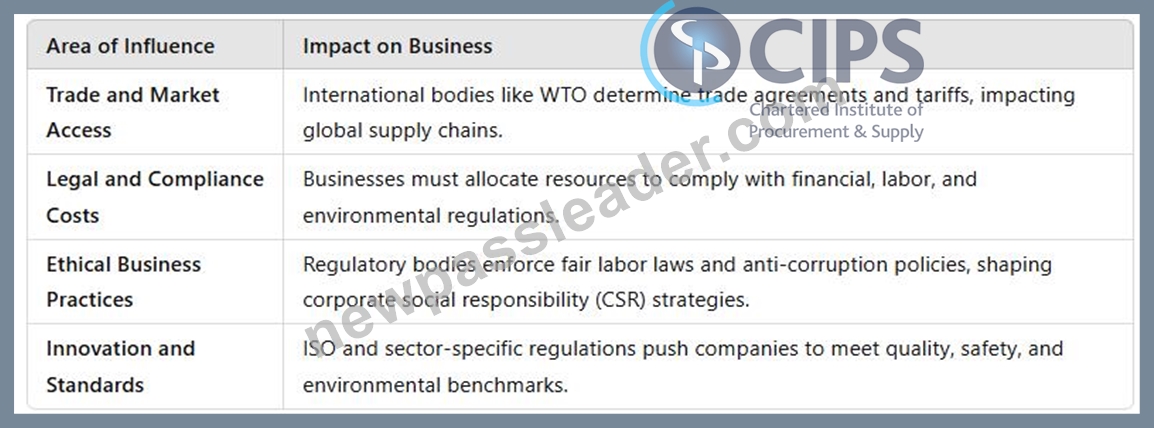
Example: The EU's General Data Protection Regulation (GDPR) forced global companies to enhance data protection policies or face heavy fines.
4. Advantages and Disadvantages of Regulatory and International Influence
✅ Advantages
Promotes Stability & Fair Competition - Reduces market manipulation and corruption.
Protects Consumers & Employees - Ensures safety, fair wages, and ethical standards.
Encourages Innovation & Sustainability - Businesses invest in R&D to meet regulatory requirements.
Facilitates Global Trade - International trade agreements create business opportunities.
❌ Disadvantages
Regulatory Burdens & Compliance Costs - Strict laws increase operational costs.
Trade Barriers & Bureaucracy - Lengthy regulatory approval processes slow down market entry.
Risk of Overregulation - Too many rules can stifle competition and innovation.
Example: The EU Emissions Trading System (EU ETS) requires manufacturers to pay for carbon emissions, increasing operational costs.
Conclusion
Industry regulators and international bodies shape the business environment by enforcing laws, ensuring ethical practices, and facilitating global trade. Companies must proactively monitor regulatory changes, integrate compliance into strategic planning, and adapt to international standards to maintain market competitiveness and sustainability.
NEW QUESTION # 16
SIMULATION
Organisations in the private sector often need to make decisions regarding financing, investment and dividends. Discuss factors that affect these decisions.
Answer:
Explanation:
Factors Affecting Financing, Investment, and Dividend Decisions in Private Sector Organizations Introduction Private sector organizations must carefully balance financing, investment, and dividend decisions to ensure financial stability, profitability, and shareholder satisfaction. These decisions are influenced by internal financial health, external economic conditions, market competition, and regulatory requirements.
This answer examines the key factors affecting financing, investment, and dividend policies in private sector companies.
1. Factors Affecting Financing Decisions (How Companies Raise Capital?) Financing decisions determine how businesses fund operations, expansion, and debt repayment.
1.1 Cost of Capital (Debt vs. Equity Considerations)
✅ Why It Matters?
Companies choose between debt financing (bank loans, bonds) and equity financing (selling shares) based on the cost of capital.
Higher interest rates make debt financing expensive, while equity financing dilutes ownership.
Example:
A startup may prefer equity financing to avoid immediate debt repayments.
A profitable company may use debt due to tax advantages on interest payments.
Key Takeaway: Companies aim to minimize capital costs while maintaining financial flexibility.
1.2 Company's Creditworthiness & Risk Tolerance
✅ Why It Matters?
Stronger credit ratings allow companies to secure loans at lower interest rates.
Riskier businesses may struggle to secure financing or face high borrowing costs.
Example:
Apple can easily issue corporate bonds due to its strong financial position.
A high-risk startup may have to offer higher interest rates on its debt.
Key Takeaway: Financially stable firms have more funding options at lower costs.
1.3 Economic Conditions (Market Trends & Inflation)
✅ Why It Matters?
In economic downturns, companies avoid excessive borrowing.
Inflation and interest rate hikes increase financing costs.
Example:
During recessions, companies reduce borrowing to avoid high debt risks.
In a booming economy, firms take loans to expand production and capture market share.
Key Takeaway: Businesses adjust financing strategies based on economic stability and interest rates.
2. Factors Affecting Investment Decisions (Where and How Companies Invest Capital?)
2.1 Expected Return on Investment (ROI)
✅ Why It Matters?
Companies evaluate potential profits from investments before committing capital.
High-ROI projects are prioritized, while low-ROI investments are avoided.
Example:
Tesla invests in battery technology due to high future demand.
A retail chain avoids investing in struggling markets with low profitability.
Key Takeaway: Businesses prioritize high-return investments that align with strategic goals.
2.2 Risk Assessment & Diversification
✅ Why It Matters?
Companies assess market, operational, and financial risks before investing.
Diversification reduces reliance on a single revenue source.
Example:
Amazon diversified into cloud computing (AWS) to reduce dependence on e-commerce sales.
Oil companies invest in renewable energy to hedge against declining fossil fuel demand.
Key Takeaway: Investment decisions focus on balancing risk and opportunity.
2.3 Availability of Internal Funds vs. External Borrowing
✅ Why It Matters?
Companies use retained earnings when available to avoid debt costs.
When internal funds are insufficient, they borrow or raise equity capital.
Example:
Google reinvests profits into AI and software development instead of taking loans.
A new airline expansion may require debt financing for aircraft purchases.
Key Takeaway: Investment decisions depend on fund availability and cost considerations.
3. Factors Affecting Dividend Decisions (How Companies Distribute Profits to Shareholders?)
3.1 Profitability & Cash Flow Stability
✅ Why It Matters?
Profitable companies pay higher dividends, while struggling firms reduce payouts.
Strong cash flow ensures consistent dividend payments.
Example:
Microsoft pays regular dividends due to its steady revenue stream.
A startup reinvests all profits into business growth instead of paying dividends.
Key Takeaway: Only profitable, cash-rich companies sustain high dividend payouts.
3.2 Growth vs. Payout Trade-Off
✅ Why It Matters?
High-growth firms reinvest profits for expansion instead of paying high dividends.
Mature companies with stable profits focus on rewarding shareholders.
Example:
Amazon reinvests heavily in logistics and AI rather than paying high dividends.
Coca-Cola pays consistent dividends as its industry growth is slower.
Key Takeaway: Companies balance growth investment and shareholder returns.
3.3 Shareholder Expectations & Market Perception
✅ Why It Matters?
Investors expect dividends, especially in blue-chip and income-focused stocks.
Sudden dividend cuts can signal financial trouble, affecting share prices.
Example:
Unilever maintains stable dividends to attract income-focused investors.
Tesla does not pay dividends, focusing on long-term growth and innovation.
Key Takeaway: Dividend policies affect investor confidence and stock valuation.
4. Summary: Key Factors Influencing Financial Decisions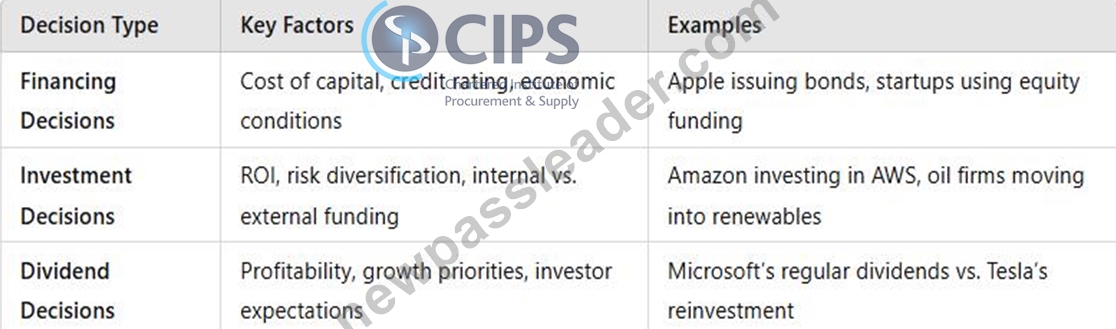
Key Takeaway: Companies balance financing, investment, and dividend decisions based on profitability, risk assessment, and market conditions.
5. Conclusion
Private sector companies make strategic financial decisions by evaluating:
✅ Financing Needs: Debt vs. equity, cost of borrowing, and risk management.
✅ Investment Priorities: Expected ROI, business growth, and market opportunities.
✅ Dividend Strategy: Balancing shareholder returns and reinvestment for growth.
Understanding these factors helps businesses maximize financial performance, shareholder value, and long-term sustainability.
NEW QUESTION # 17
SIMULATION
Evaluate the role of strategic human management in creating competitive advantage for an organisation
Answer:
Explanation:
Evaluation of the Role of Strategic Human Resource Management (SHRM) in Creating Competitive Advantage Introduction Strategic Human Resource Management (SHRM) is the proactive alignment of HR policies with business strategy to achieve long-term success. It focuses on developing talent, leadership, culture, and employee engagement to enhance organizational performance and competitiveness.
By implementing effective SHRM practices, companies can create a sustainable competitive advantage through a highly skilled and motivated workforce.
1. The Role of SHRM in Creating Competitive Advantage
1.1 Talent Acquisition and Workforce Planning
✅ Why it matters?
Recruiting and retaining highly skilled employees is essential for innovation and efficiency.
Workforce planning ensures the right people are in the right roles at the right time.
Example: Google's strategic hiring approach focuses on attracting top AI and engineering talent, driving innovation in tech.
✅ Competitive Advantage Created:
✔ Builds an expert workforce that competitors cannot easily replicate.
✔ Reduces turnover costs by ensuring long-term retention.
1.2 Employee Development and Training
✅ Why it matters?
Continuous learning and skills development enhance employee productivity and innovation.
Upskilling employees keeps companies ahead in fast-changing industries.
Example: Amazon's Career Choice Program invests in employee training to develop future leaders and improve workforce capabilities.
✅ Competitive Advantage Created:
✔ Enhances organizational agility by equipping employees with emerging skills.
✔ Creates a culture of continuous improvement and innovation.
1.3 Performance Management and Employee Engagement
✅ Why it matters?
Effective performance management systems ensure employees align with business goals.
Engaged employees are more productive, motivated, and committed to company success.
Example: Salesforce's focus on employee engagement through leadership development and internal career growth has resulted in high retention and innovation.
✅ Competitive Advantage Created:
✔ Drives high workforce productivity and efficiency.
✔ Reduces costs related to poor performance and disengagement.
1.4 HR Technology and Data-Driven Decision-Making
✅ Why it matters?
Digital HR tools (e.g., AI-driven recruitment, performance analytics, HR automation) optimize talent management.
Data-driven HR strategies help predict workforce trends and talent gaps.
Example: Unilever uses AI-driven HR analytics to identify high-potential employees and enhance leadership succession planning.
✅ Competitive Advantage Created:
✔ Enables data-driven workforce planning for future growth.
✔ Increases efficiency and reduces hiring biases.
1.5 Employee Well-being and Diversity & Inclusion
✅ Why it matters?
Work-life balance policies, mental health support, and DEI (Diversity, Equity, Inclusion) programs improve workplace culture.
Diverse teams enhance creativity, problem-solving, and innovation.
Example: Microsoft's Diversity & Inclusion programs have strengthened its brand and innovation by fostering a more inclusive workforce.
✅ Competitive Advantage Created:
✔ Attracts top global talent who seek inclusive workplaces.
✔ Strengthens brand reputation and employee loyalty.
2. Advantages of Strategic HRM in Competitive Positioning
✅ Develops Unique Talent & Expertise - Hard for competitors to replicate.
✅ Enhances Productivity & Efficiency - Skilled, engaged employees drive better results.
✅ Supports Business Agility & Innovation - Workforce is adaptable to market changes.
✅ Builds Strong Employer Brand - Attracts and retains high-quality talent.
Key Takeaway: SHRM transforms HR from an administrative function to a strategic asset that creates long-term value.
3. Challenges & Risks of SHRM
❌ Implementation Costs - Advanced HR technology and training require investment.
❌ Resistance to Change - Employees may resist new HR policies.
❌ Measuring ROI Can Be Complex - Talent development impacts long-term but is hard to quantify.
❌ Legal & Compliance Risks - Global HR policies must align with labor laws across different countries.
Solution: Businesses must integrate HR analytics, leadership buy-in, and cultural change strategies to overcome these challenges.
4. Conclusion
Strategic Human Resource Management (SHRM) is a key driver of sustainable competitive advantage by:
✅ Attracting and retaining top talent.
✅ Developing a highly skilled, engaged, and innovative workforce.
✅ Leveraging HR technology and data-driven insights.
✅ Promoting employee well-being, diversity, and inclusion.
Companies that prioritize SHRM create a dynamic, future-ready workforce, ensuring long-term success in competitive markets.
NEW QUESTION # 18
SIMULATION
Discuss the difference between a merger and an acquisition. What are the main drivers and risks associated with this approach to growth compared to an organic development strategy?
Answer:
Explanation:
Mergers vs. Acquisitions: Drivers, Risks, and Comparison to Organic Growth Introduction Businesses seeking growth can expand through mergers and acquisitions (M&A) or by organic development. Mergers and acquisitions involve external growth strategies, where companies combine forces or take over another business, whereas organic growth occurs internally through investment in operations, R&D, and market expansion.
While M&A strategies provide rapid expansion and competitive advantages, they also carry integration risks and financial complexities compared to organic growth.
1. Difference Between a Merger and an Acquisition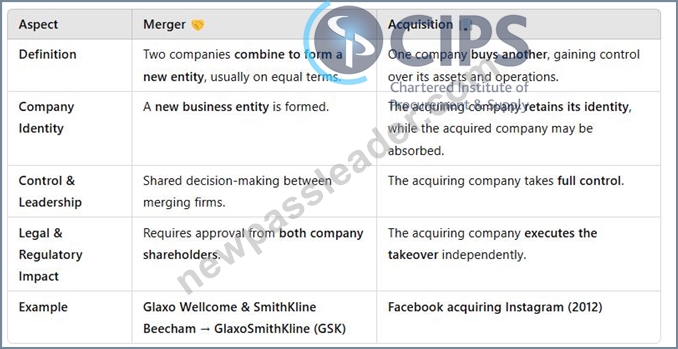
Key Takeaway: Mergers are usually collaborative, while acquisitions involve one company dominating another.
2. Main Drivers of Mergers & Acquisitions (M&A)
1. Market Expansion & Faster Growth
✅ Provides immediate access to new markets, customers, and geographies.
✅ Faster than organic growth, allowing firms to scale operations quickly.
Example: Amazon's acquisition of Whole Foods gave it an instant presence in the grocery sector.
2. Cost Synergies & Efficiency Gains
✅ Reduces duplication of functions (e.g., shared IT, supply chain).
✅ Achieves economies of scale, lowering operating costs.
Example: Disney's acquisition of 21st Century Fox reduced production costs by consolidating media assets.
3. Competitive Advantage & Market Power
✅ Eliminates competition by absorbing rival firms.
✅ Strengthens bargaining power over suppliers and distributors.
Example: Google acquiring YouTube removed a major competitor in the video-sharing industry.
4. Access to New Technology & Innovation
✅ Fast-tracks adoption of emerging technologies.
✅ Avoids lengthy in-house R&D development cycles.
Example: Microsoft's acquisition of LinkedIn gave it access to AI-driven professional networking tools.
3. Risks of Mergers & Acquisitions
1. Cultural & Operational Integration Challenges
❌ Employees from different companies may resist integration, leading to conflicts.
❌ Different corporate cultures may result in productivity loss.
Example: The Daimler-Chrysler merger failed due to cultural clashes between German and American management styles.
2. High Financial Costs & Debt Risks
❌ Acquiring companies often take on large amounts of debt.
❌ M&A deals may overvalue the target company, leading to losses.
Example: AOL's acquisition of Time Warner ($165 billion) resulted in huge financial losses due to overvaluation.
3. Regulatory and Legal Barriers
❌ Government regulators may block mergers due to monopoly concerns.
❌ Legal challenges may delay or cancel deals.
Example: The EU blocked Siemens and Alstom's rail merger due to competition concerns.
4. Disruption to Core Business
❌ Management focus on M&A can distract from existing operations.
❌ Post-merger integration complexities can lead to delays and inefficiencies.
Example: HP's acquisition of Compaq resulted in years of internal restructuring, impacting performance.
4. Comparison: M&A vs. Organic Growth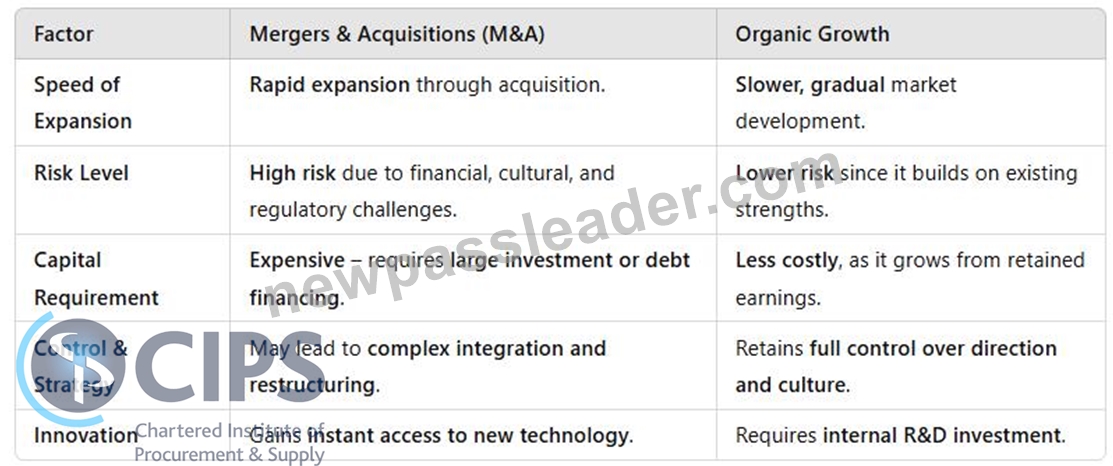
Key Takeaway: M&A provides fast expansion but comes with higher risks, whereas organic growth is slower but more sustainable.
5. Conclusion
Mergers and acquisitions offer a fast-track to market leadership, providing growth, cost synergies, and competitive advantages. However, they also carry significant financial, cultural, and regulatory risks compared to organic growth.
✅ Best for: Companies needing rapid expansion, technology access, or competitive positioning.
❌ Risky when: Poor cultural integration, excessive debt, or regulatory obstacles arise.
Businesses must carefully assess strategic fit, financial feasibility, and post-merger integration plans before choosing M&A as a growth strategy.
NEW QUESTION # 19
SIMULATION
Explain the use of forward and future contracts in the commodities market
Answer:
Explanation:
Use of Forward and Futures Contracts in the Commodities Market
Introduction
The commodities market involves the trading of physical goods such as oil, gold, agricultural products, and metals. Due to price volatility, businesses and investors use derivative contracts like forward and futures contracts to manage price risk and ensure stability in supply chains.
Both contracts allow buyers and sellers to agree on a fixed price for a future date, but they differ in terms of standardization, trading methods, and risk exposure.
1. Forward Contracts (Private, Custom Agreements)
Definition
A forward contract is a customized agreement between two parties to buy or sell a commodity at a specified price on a future date. It is a private, over-the-counter (OTC) contract, meaning it is not traded on an exchange.
✅ Key Characteristics:
Customizable terms (quantity, delivery date, price).
Direct agreement between buyer and seller.
Used for hedging against price fluctuations.
Example: A coffee producer agrees to sell 10,000kg of coffee to a distributor in 6 months at a fixed price of $5 per kg, protecting both parties from price swings.
Advantages of Forward Contracts
✔ Tailored to buyer/seller needs - Customizable quantity, quality, and delivery terms.
✔ Reduces price uncertainty - Locks in a price, protecting against market fluctuations.
✔ No upfront cost - No initial margin or collateral required.
Disadvantages of Forward Contracts
❌ High counterparty risk - If one party defaults, the other may face financial losses.
❌ Not regulated or publicly traded - Higher risk of contract disputes.
❌ Limited liquidity - Harder to transfer or sell compared to futures contracts.
Best for: Companies looking for customized price protection in procurement or sales (e.g., food manufacturers, oil refineries).
2. Futures Contracts (Standardized, Exchange-Traded Agreements)
Definition
A futures contract is a standardized agreement to buy or sell a commodity at a predetermined price on a future date. These contracts are traded on organized exchanges (e.g., Chicago Mercantile Exchange (CME), London Metal Exchange (LME)).
✅ Key Characteristics:
Highly regulated and standardized (fixed contract sizes and terms).
Exchange-traded → Increased liquidity and price transparency.
Requires initial margin and daily settlements (mark-to-market system).
Example: A wheat farmer uses futures contracts on the Chicago Board of Trade (CBOT) to lock in wheat prices before harvest, avoiding potential price drops.
Advantages of Futures Contracts
✔ Lower counterparty risk - Exchanges guarantee contract settlement.
✔ High liquidity - Easily bought or sold on futures markets.
✔ Price transparency - Publicly available pricing and standardized contracts.
Disadvantages of Futures Contracts
❌ Less flexibility - Fixed contract sizes and expiration dates.
❌ Margin requirements - Traders must maintain a margin account, requiring cash reserves.
❌ Potential for speculative losses - Prices fluctuate daily, leading to possible margin calls.
Best for: Large-scale buyers/sellers, investors, and companies needing risk management in commodity markets.
3. Key Differences Between Forward and Futures Contracts
Key Takeaway: Forwards offer flexibility but higher risk, while futures provide standardization and liquidity.
4. Application of Forward and Futures Contracts in the Commodities Market Forwards Used By:
✅ Food manufacturers - Locking in wheat, sugar, or coffee prices for future production.
✅ Oil refineries - Securing crude oil prices to manage fuel costs.
✅ Mining companies - Pre-agreeing on metal prices to secure revenue streams.
Futures Used By:
✅ Airlines - Hedging against fluctuating fuel prices.
✅ Investors - Speculating on gold, oil, or agricultural prices for profit.
✅ Governments - Stabilizing national food or energy reserves.
5. Conclusion
Both forward and futures contracts are essential tools in the commodities market for price risk management.
✅ Forward contracts are customizable but riskier, making them suitable for businesses with specific procurement needs.
✅ Futures contracts offer liquidity and reduced counterparty risk, making them ideal for investors and large corporations managing price volatility.
Organizations must choose the right contract based on their risk tolerance, market exposure, and financial objectives.
NEW QUESTION # 20
SIMULATION
Evaluate the following approaches to supply chain management: the Business Excellence Model, Top-Down Management Approach and Six Sigma
Answer:
Explanation:
Evaluation of Approaches to Supply Chain Management
Introduction
Effective supply chain management (SCM) is critical for organizations to enhance efficiency, reduce costs, and improve customer satisfaction. Various management approaches help organizations optimize their supply chain performance. Three widely recognized approaches include:
Business Excellence Model (BEM) - A framework for continuous improvement.
Top-Down Management Approach - A hierarchical decision-making structure.
Six Sigma - A data-driven methodology for process improvement.
Each approach has strengths and limitations when applied to supply chain management.
1. Business Excellence Model (BEM) in Supply Chain Management
Explanation:
The Business Excellence Model (BEM) is a holistic framework used to assess and improve business performance. The European Foundation for Quality Management (EFQM) Excellence Model is one of the most common BEM frameworks.
It focuses on 9 key criteria: Leadership, Strategy, People, Partnerships & Resources, Processes, Customer Results, People Results, Society Results, and Business Performance.
Application in Supply Chain Management
✅ Encourages continuous improvement in supplier relationships and logistics.
✅ Focuses on customer-centric supply chain strategies.
✅ Promotes collaboration with suppliers and stakeholders to optimize efficiency.
Example: Toyota's Lean Supply Chain follows BEM principles to maintain supplier partnerships and quality improvement.
Evaluation
✅ Advantages
Provides a structured framework for evaluating supply chain performance.
Enhances collaboration between internal teams and external suppliers.
Focuses on quality management and customer satisfaction.
❌ Limitations
Can be complex and resource-intensive to implement.
Requires cultural change and strong leadership commitment.
2. Top-Down Management Approach in Supply Chain Management
Explanation:
The Top-Down Management Approach follows a hierarchical structure where decisions are made by senior management and communicated downward. This approach ensures centralized decision-making and strong leadership control.
Application in Supply Chain Management
✅ Ensures consistency in supply chain policies and strategic direction.
✅ Facilitates quick decision-making in procurement and logistics.
✅ Helps maintain compliance with regulatory standards and corporate policies.
Example: Amazon's Supply Chain Strategy is largely top-down, with executives making key strategic decisions on warehousing, delivery, and automation.
Evaluation
✅ Advantages
Ensures strong leadership direction in supply chain management.
Reduces confusion in decision-making by maintaining clear authority.
Useful for large-scale global supply chains that need standardization.
❌ Limitations
Can be rigid and slow to adapt to changing supply chain disruptions.
May reduce innovation and employee engagement in problem-solving.
Less effective in dynamic, fast-changing industries.
3. Six Sigma in Supply Chain Management
Explanation:
Six Sigma is a data-driven methodology aimed at reducing defects and improving quality. It follows the DMAIC cycle (Define, Measure, Analyze, Improve, Control) to enhance process efficiency and minimize errors.
Application in Supply Chain Management
✅ Helps identify waste and inefficiencies in supply chain processes.
✅ Reduces defects and errors in procurement, logistics, and inventory management.
✅ Enhances supplier performance evaluation through data analysis.
Example: General Electric (GE) used Six Sigma to improve supply chain efficiency, reducing defects and operational costs.
Evaluation
✅ Advantages
Reduces supply chain disruptions by improving process reliability.
Uses data-driven decision-making for procurement and logistics.
Improves supplier quality management.
❌ Limitations
Requires intensive training and certification (Black Belt, Green Belt, etc.).
Can be too rigid for industries requiring flexibility and innovation.
Implementation may be costly and time-consuming.
Conclusion
Each approach offers unique benefits for supply chain management:
BEM ensures a holistic, continuous improvement framework for supply chains.
Top-Down Management provides strong leadership direction and centralized decision-making.
Six Sigma improves process quality and operational efficiency.
Organizations should combine these approaches based on their business model, industry requirements, and strategic goals to optimize supply chain performance.
NEW QUESTION # 21
SIMULATION
Analyse the GE McKinsey Matrix as a tool to influence directional policy
Answer:
Explanation:
Analysis of the GE McKinsey Matrix as a Tool to Influence Directional Policy Introduction The GE McKinsey Matrix is a strategic tool used by businesses to prioritize investments, allocate resources, and influence directional policy. It expands on the BCG Matrix by evaluating business units or product portfolios based on two dimensions:
Industry Attractiveness (external factors such as market growth, competition, and profitability).
Business Unit Strength (internal factors such as brand strength, financial performance, and operational efficiency).
The matrix helps organizations decide where to invest, grow, or divest, making it a valuable tool for influencing long-term strategic direction.
1. Explanation of the GE McKinsey Matrix
The GE McKinsey Matrix categorizes business units into nine strategic zones, guiding investment decisions:
| Industry Attractiveness →
Example:
Apple's iPhone (High Industry, Strong Business Unit) → Invest & Grow
Microsoft's Bing Search Engine (Low Industry, Weak Business Unit) → Divest or Harvest ❌
2. How the GE McKinsey Matrix Influences Directional Policy
1. Investment Prioritization
✅ Identifies which business units deserve more investment.
✅ Helps companies allocate resources to high-potential markets.
Example: Amazon invests heavily in AWS (Cloud Computing) due to high industry growth and strong business positioning.
2. Market Entry and Expansion Decisions
✅ Assists in geographical and market expansion decisions.
✅ Helps assess whether to enter emerging industries.
Example: Tesla entered renewable energy (solar panels, batteries) due to high industry potential.
3. Strategic Exit or Divestment Decisions
✅ Identifies low-performing divisions that should be divested.
✅ Prevents financial losses by exiting declining markets.
Example: GE sold its financial services division (GE Capital) to refocus on industrial manufacturing.
4. Balancing Risk and Portfolio Diversification
✅ Encourages a balanced portfolio of high-growth and stable businesses.
✅ Ensures companies avoid over-reliance on a single product or market.
Example: Google (Alphabet) maintains a diverse portfolio of AI, search, and cloud businesses to balance risk.
3. Advantages and Limitations of the GE McKinsey Matrix
✅ Advantages
✔ More detailed than the BCG Matrix - Considers multiple industry and business factors.
✔ Helps with long-term strategic planning - Guides investment, expansion, and divestment.
✔ Balances risk and growth - Prevents over-reliance on a single revenue source.
❌ Limitations
✖ Subjective analysis - Industry attractiveness and business strength are difficult to quantify.
✖ Complex implementation - Requires detailed data collection and industry research.
✖ No direct action plan - Only provides guidance on resource allocation, not execution strategies.
4. Conclusion
The GE McKinsey Matrix is a powerful tool for influencing directional policy by helping companies prioritize investments, expand into attractive markets, and exit underperforming businesses. However, it should be used alongside financial analysis and market research to ensure strategic success.
NEW QUESTION # 22
SIMULATION
Discuss 5 tasks of strategic management
Answer:
Explanation:
Five Key Tasks of Strategic Management
Introduction
Strategic management involves formulating, implementing, and evaluating a company's long-term goals to achieve competitive advantage. It ensures that an organization effectively aligns its resources, capabilities, and market position to meet its objectives.
The strategic management process can be broken down into five key tasks:
1. Setting Vision, Mission, and Objectives
Strategic management begins with defining the organization's purpose and direction.
✅ Vision Statement: Describes the long-term aspirations of the business.
✅ Mission Statement: Outlines the core purpose and values.
✅ Objectives: Establish specific, measurable goals (e.g., market expansion, profitability targets).
Example:
Tesla's vision is to accelerate the world's transition to sustainable energy.
XYZ Construction might set a strategic objective to become the UK's leading sustainable housing developer.
2. Environmental Scanning and Analysis
Organizations must assess internal and external environments to identify opportunities and threats.
✅ External Analysis - Uses PESTLE (Political, Economic, Social, Technological, Legal, Environmental) and Porter's Five Forces to assess market conditions.
✅ Internal Analysis - Uses VRIO (Value, Rarity, Imitability, Organization) and SWOT (Strengths, Weaknesses, Opportunities, Threats) to evaluate internal capabilities.
Example:
A global beverage company may conduct PESTLE analysis to assess regulatory changes in sugar taxation.
XYZ Construction may analyze rising material costs and explore alternative suppliers.
3. Strategy Formulation
After analyzing the environment, the organization develops its strategic choices:
✅ Corporate-Level Strategy: Determines growth direction (e.g., diversification, mergers, acquisitions).
✅ Business-Level Strategy: Focuses on competitive advantage (e.g., cost leadership, differentiation, or niche market strategies).
✅ Functional-Level Strategy: Aligns departments (procurement, HR, marketing) with the corporate strategy.
Example:
XYZ Construction could adopt a cost leadership strategy by sourcing materials more efficiently.
Apple follows a differentiation strategy by focusing on innovation and design.
4. Strategy Implementation
Once a strategy is formulated, it must be executed effectively.
✅ Organizational Structure: Ensures the right teams and leadership are in place.
✅ Change Management: Employees must accept and support the strategy (overcoming resistance to change).
✅ Resource Allocation: Financial, technological, and human resources must be assigned effectively.
Example:
XYZ Construction might invest in new project management software to improve efficiency.
Amazon continuously optimizes its logistics network to implement its cost leadership strategy.
5. Strategy Evaluation and Control
Organizations must monitor performance to ensure the strategy remains effective.
✅ Key Performance Indicators (KPIs): Measure progress (e.g., sales growth, cost reduction).
✅ Feedback & Adaptation: Adjust strategies based on market trends and competitor actions. Risk Management: Identify and mitigate risks (e.g., economic downturns, supply chain disruptions).
Example:
XYZ Construction may review project completion times and adjust its approach for greater efficiency.
McDonald's continuously adapts its menu based on regional preferences and customer feedback.
Conclusion
The five key tasks of strategic management-setting objectives, environmental scanning, strategy formulation, strategy implementation, and evaluation-help organizations achieve long-term success and competitive advantage. Effective strategic management ensures that companies stay agile in dynamic markets while making informed, data-driven decisions.
NEW QUESTION # 23
SIMULATION
XYZ is a manufacturing company based in the UK. It has a large complex supply chain and imports raw materials from Argentina and South Africa. It sells completed products internationally via their website. Evaluate the role of licencing and taxation on XYZ's operations.
Answer:
Explanation:
Evaluation of the Role of Licensing and Taxation on XYZ's Operations
Introduction
Licensing and taxation play a critical role in international trade, supply chain management, and overall financial performance. For XYZ, a UK-based manufacturing company that imports raw materials from Argentina and South Africa and sells internationally via an e-commerce platform, compliance with licensing and taxation regulations is essential to ensure smooth operations, cost efficiency, and legal compliance.
This evaluation will assess the impact of licensing and taxation on XYZ's global supply chain, import/export activities, and financial performance.
1. The Role of Licensing in XYZ's Operations
1.1 Import and Export Licensing Regulations
As XYZ imports raw materials from Argentina and South Africa, it must comply with the UK's import licensing requirements and trade agreements with these countries.
✅ Impact on XYZ:
Import licenses may be required for certain restricted raw materials (e.g., metals, chemicals, agricultural products).
Export control laws may apply, depending on the destination of final products.
Delays or fines may occur if licenses are not properly managed.
Example: If XYZ imports metal components subject to UK trade restrictions, it must secure import licenses before shipment clearance.
1.2 Industry-Specific Licensing Requirements
Some industries require special licenses to manufacture and sell products globally.
✅ Impact on XYZ:
If XYZ manufactures electronics or chemical-based products, it may need compliance certifications (e.g., CE marking in the EU, FDA approval in the US).
Failure to meet licensing requirements can block international sales.
Example: A UK manufacturer selling medical devices must obtain MHRA (Medicines and Healthcare products Regulatory Agency) approval before distributing products.
1.3 E-Commerce & Digital Sales Licensing
As XYZ sells its products internationally via its website, it must comply with:
✅ Consumer Protection Laws (e.g., GDPR for EU customers).
✅ E-commerce business registration and online sales regulations.
Example: XYZ may need a VAT number in the EU if it sells products to European customers via its website.
2. The Role of Taxation in XYZ's Operations
2.1 Import Duties and Tariffs
XYZ's supply chain involves importing raw materials from Argentina and South Africa, which may attract import duties and tariffs.
✅ Impact on XYZ:
Higher import duties increase raw material costs and impact profitability.
Tariff-free trade agreements (e.g., UK-South Africa trade deal) may reduce costs.
Post-Brexit UK-EU trade regulations may affect supply chain tax structures.
Example: If the UK imposes high tariffs on South African goods, XYZ may need to find alternative suppliers or negotiate better deals.
2.2 Corporate Tax & International Tax Compliance
XYZ must comply with UK corporate tax laws and international taxation regulations.
✅ Impact on XYZ:
Paying corporate tax in the UK based on global sales revenue.
Managing international tax obligations when selling in multiple countries.
Risk of double taxation if the same income is taxed in multiple jurisdictions.
Example: If XYZ sells products in Germany and the US, it may need to register for tax in those countries and comply with local VAT/GST requirements.
2.3 Value Added Tax (VAT) & Sales Tax
Since XYZ sells internationally via its website, it must adhere to global VAT and sales tax rules.
✅ Impact on XYZ:
In the EU, VAT registration is required for online sales above a certain threshold.
In the US, sales tax regulations vary by state.
Compliance with UK VAT laws (e.g., 20% standard rate) on domestic sales.
Example: A UK company selling online to EU customers must comply with the EU One-Stop-Shop (OSS) VAT scheme.
2.4 Transfer Pricing & Tax Efficiency
If XYZ has international subsidiaries or supply chain partners, it must manage transfer pricing regulations.
✅ Impact on XYZ:
Ensuring fair pricing between UK operations and overseas suppliers to avoid tax penalties.
Optimizing tax-efficient supply chain structures to minimize tax burdens.
Example: Multinational companies like Apple and Amazon use tax-efficient structures to reduce liabilities.
3. Strategic Actions for XYZ to Manage Licensing and Taxation Effectively XYZ can take several steps to optimize tax compliance and licensing efficiency: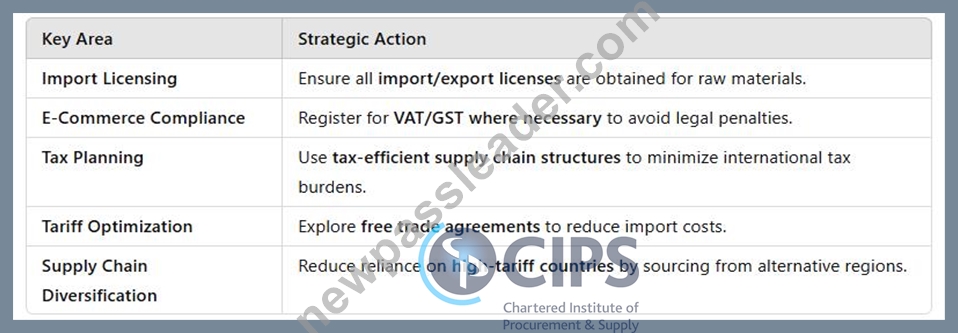
Conclusion
Licensing and taxation have a major impact on XYZ's international manufacturing and e-commerce operations. To maintain profitability and regulatory compliance, XYZ must:
✅ Ensure import/export licensing aligns with UK and international trade laws.
✅ Manage import duties, VAT, and corporate tax obligations effectively.
✅ Optimize its supply chain and tax planning to reduce costs.
By proactively managing these areas, XYZ can enhance its global competitiveness while minimizing risks.
NEW QUESTION # 24
SIMULATION
Evaluate the following approaches to strategy formation: intended strategy and emergent strategy
Answer:
Explanation:
Evaluation of Intended Strategy vs. Emergent Strategy
Introduction
Strategy formation is a critical process that determines how businesses achieve their objectives. Two contrasting approaches exist:
Intended Strategy - A deliberate, planned approach, where management defines a clear course of action.
Emergent Strategy - A flexible, adaptive approach, where strategy evolves in response to external changes.
Both approaches have advantages and constraints, and organizations often combine both to maintain strategic direction while adapting to market uncertainties.
1. Intended Strategy(Planned Approach to Strategy Formation)
Definition
An intended strategy is a structured, pre-planned approach where an organization sets long-term goals and develops a roadmap to achieve them.
✅ Key Characteristics:
Clearly defined mission, vision, and objectives.
Top-down decision-making with structured implementation plans.
Focus on forecasting, market research, and competitor analysis.
Example:
McDonald's follows an intended strategy by expanding its franchise model using structured business plans and operational guidelines.
Advantages of Intended Strategy
✔ Provides a clear vision and direction - Ensures all departments align with corporate goals.
✔ Supports long-term resource allocation - Helps in budgeting and investment planning.
✔ Enhances risk management - Allows organizations to prepare for potential challenges.
✔ Ensures consistency - Ideal for stable industries with predictable market conditions.
Constraints of Intended Strategy
❌ Inflexible in dynamic markets - Struggles with unforeseen changes (e.g., economic crises, technology shifts).
❌ Can lead to missed opportunities - Focuses on execution rather than adaptation.
❌ Slow response time - Delays decision-making in fast-changing industries.
Key Takeaway: Intended strategy works best in stable environments where long-term planning can be executed without major disruptions.
2. Emergent Strategy(Flexible & Adaptive Approach to Strategy Formation) Definition An emergent strategy is a responsive, flexible approach where businesses adapt their strategies based on real-time changes in the market.
✅ Key Characteristics:
Strategy emerges from trial and error, experimentation, and learning.
Encourages bottom-up decision-making, allowing employees to contribute.
Focuses on short-term flexibility and continuous adjustments.
Example:
Amazon's move into cloud computing (AWS) was an emergent strategy, as it originally started as an online bookstore but adapted to market opportunities.
Advantages of Emergent Strategy
✔ Highly adaptable - Allows businesses to pivot in response to market shifts.
✔ Encourages innovation and experimentation - Promotes new ideas and flexible problem-solving.
✔ Reduces risk of failure - Companies can adjust strategies before fully committing to large-scale investments.
✔ Works well in unpredictable environments - Essential for industries like technology, fashion, and e-commerce.
Constraints of Emergent Strategy
❌ Lack of clear direction - Can create confusion in organizations with no defined strategic goals.
❌ Resource inefficiency - Constant adjustments may lead to wasted time and investment.
❌ Difficult to scale - Unstructured decision-making can cause inconsistencies.
Key Takeaway: Emergent strategy is ideal for fast-changing industries where adaptability is more valuable than rigid planning.
3. Comparison: Intended Strategy vs. Emergent Strategy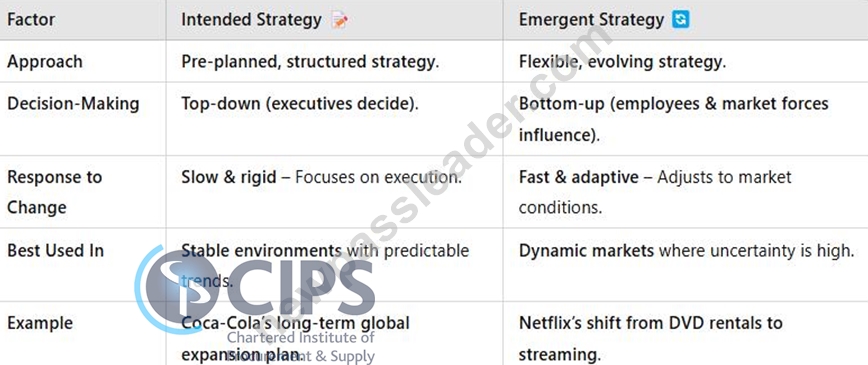
Key Takeaway: Most successful organizations blend both approaches, using intended strategy for stability and emergent strategy for adaptability.
4. Conclusion
Both intended and emergent strategies have strengths and weaknesses.
✅ Intended strategy is best for structured, long-term growth in stable industries.
✅ Emergent strategy allows for rapid adaptation in volatile markets.
✅ Most businesses use a combination of both approaches, balancing planning with flexibility.
By integrating intended and emergent strategies, organizations can maintain stability while responding effectively to market changes.
NEW QUESTION # 25
SIMULATION
Provide a definition of a commodity product. What role does speculation and hedging play in the commodities market?
Answer:
Explanation:
Commodity Products and the Role of Speculation & Hedging in the Commodities Market
1. Definition of a Commodity Product
A commodity product is a raw material or primary agricultural product that is uniform in quality and interchangeable with other products of the same type, regardless of the producer.
✅ Key Characteristics:
Standardized and homogeneous - Little differentiation between producers.
Traded on global markets - Bought and sold on commodity exchanges.
Price determined by supply & demand - Subject to market fluctuations.
Examples of Commodity Products:
Agricultural Commodities - Wheat, corn, coffee, cotton.
Energy Commodities - Crude oil, natural gas, coal.
Metals & Minerals - Gold, silver, copper, aluminum.
Key Takeaway: Commodities are essential goods used in global trade, where price is the primary competitive factor.
2. The Role of Speculation in the Commodities Market
Definition
Speculation involves buying and selling commodities for profit rather than for actual use, based on price predictions.
✅ How Speculation Works:
Traders and investors buy commodities expecting price increases (long positions).
They sell commodities expecting price declines (short positions).
No physical exchange of goods-transactions are purely financial.
Example:
A trader buys crude oil futures at $70 per barrel, expecting prices to rise. If oil reaches $80 per barrel, the trader sells for profit.
Advantages of Speculation
✔ Increases market liquidity - More buyers and sellers improve trading efficiency.
✔ Enhances price discovery - Helps determine fair market value.
✔ Absorbs market risk - Speculators take risks that producers or consumers avoid.
Disadvantages of Speculation
❌ Creates excessive volatility - Large speculative trades can cause price spikes or crashes.
❌ Detaches prices from real supply and demand - Can inflate bubbles or cause artificial declines.
❌ Market manipulation risks - Speculators with large holdings can distort prices.
Key Takeaway: Speculation adds liquidity and helps price discovery, but can lead to extreme volatility if unchecked.
3. The Role of Hedging in the Commodities Market
Definition
Hedging is a risk management strategy used by commodity producers and consumers to protect against price fluctuations.
✅ How Hedging Works:
Producers (e.g., farmers, oil companies) use futures contracts to lock in a price for future sales, reducing the risk of price drops.
Consumers (e.g., airlines, food manufacturers) hedge to secure stable input costs, avoiding sudden price surges.
Example:
An airline hedges against rising fuel costs by buying fuel futures at a fixed price for the next 12 months. If fuel prices rise, the airline is protected from increased expenses.
Advantages of Hedging
✔ Stabilizes revenue and costs - Helps businesses plan with certainty.
✔ Protects against price swings - Reduces exposure to unpredictable market conditions.
✔ Encourages long-term investment - Producers and buyers operate with confidence.
Disadvantages of Hedging
❌ Reduces potential profits - If prices move favorably, hedgers miss out on gains.
❌ Contract obligations - Hedgers must honor contract terms, even if market prices improve.
❌ Hedging costs - Fees and contract costs can be high.
Key Takeaway: Hedging protects businesses from commodity price risk, ensuring stable revenue and cost control.
4. Speculation vs. Hedging: Key Differences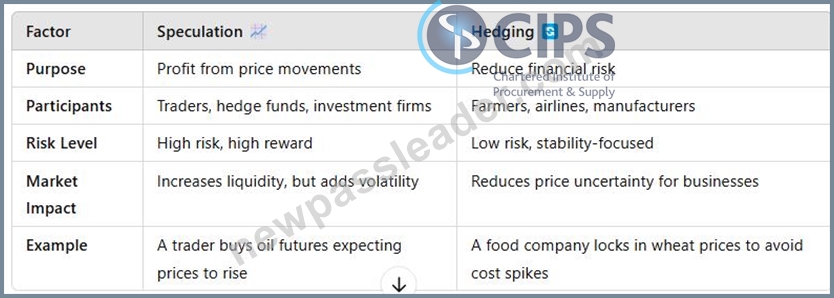
Key Takeaway: Speculation seeks profit from price changes, while hedging minimizes risk from price fluctuations.
5. Conclusion
✅ Commodity products are standardized raw materials traded globally, with prices driven by supply and demand dynamics.
✅ Speculation brings liquidity and price discovery but can increase volatility.
✅ Hedging helps businesses stabilize costs and revenues, ensuring financial predictability.
✅ Both strategies play essential roles in ensuring a balanced, functional commodities market.
NEW QUESTION # 26
SIMULATION
Evaluate the following types of business structures: simple, functional, multi-divisional and matrix, explaining the advantages and disadvantages of each.
Answer:
Explanation:
Evaluation of Business Structures: Simple, Functional, Multi-Divisional, and Matrix Introduction A company's business structure defines how it organizes its people, processes, and decision-making hierarchy. The right structure helps an organization operate efficiently, communicate effectively, and achieve strategic goals.
This answer evaluates four common business structures:
Simple Structure - Small, centralized decision-making.
Functional Structure - Organized by business functions (e.g., marketing, finance).
Multi-Divisional Structure - Separate divisions with decentralized decision-making.
Matrix Structure - A hybrid of functional and project-based management.
Each structure has advantages and disadvantages that impact efficiency, flexibility, and strategic execution.
1. Simple Structure(Small, Centralized Organization)
Explanation:
A simple structure is typically used by small businesses or startups with few employees and direct leadership by the owner or CEO.
✅ Key Characteristics:
Centralized decision-making.
Minimal bureaucracy and hierarchy.
Quick adaptability to changes.
Example: A local retail store or family-owned restaurant where the owner makes all key decisions.
Advantages of a Simple Structure
✔ Fast decision-making - No complex approval processes.
✔ Flexible and adaptable - Can quickly respond to market changes.
✔ Low operational costs - Minimal administrative expenses.
Disadvantages of a Simple Structure
❌ Lack of scalability - Difficult to manage growth.
❌ Over-reliance on leadership - If the owner is absent, decision-making stalls.
❌ Limited specialization - Employees often perform multiple roles, reducing efficiency.
Best for: Small businesses, early-stage startups, and family-run companies.
2. Functional Structure(Organized by Department Functions)
Explanation:
A functional structure groups employees based on business functions (e.g., HR, finance, marketing, operations).
✅ Key Characteristics:
Specialization within departments.
Clear lines of authority.
Efficient division of work.
Example: A manufacturing company with dedicated teams for production, sales, HR, and R&D.
Advantages of a Functional Structure
✔ Encourages specialization - Employees develop expertise.
✔ Efficient resource allocation - Reduces duplication of roles.
✔ Clear chain of command - Reduces confusion in reporting lines.
Disadvantages of a Functional Structure
❌ Silos between departments - Poor cross-functional communication.
❌ Slow decision-making - Requires coordination across departments.
❌ Limited flexibility - Harder to respond quickly to market shifts.
Best for: Medium to large firms in stable industries (e.g., banks, insurance companies, government agencies).
3. Multi-Divisional Structure (M-Form)(Organized by Business Units or Divisions) Explanation:
A multi-divisional structure consists of separate business units (divisions), each operating independently under a corporate headquarters.
✅ Key Characteristics:
Decentralized decision-making at the divisional level.
Each division focuses on a specific product, market, or region.
Corporate HQ oversees strategic direction.
Example: Unilever operates multiple divisions for food, beauty, and household products, each with its own leadership team.
Advantages of a Multi-Divisional Structure
✔ Faster decision-making - Divisions operate autonomously.
✔ Better market responsiveness - Each unit focuses on its unique customers.
✔ Risk diversification - If one division underperforms, others can offset losses.
Disadvantages of a Multi-Divisional Structure
❌ Higher operational costs - Each division requires management and resources.
❌ Duplication of functions - HR, marketing, and finance teams may exist in multiple divisions.
❌ Potential competition between divisions - Internal rivalry may slow down collaboration.
Best for: Large corporations with diverse product lines or global operations (e.g., Toyota, Amazon, PepsiCo).
4. Matrix Structure(Dual Reporting: Functional & Project-Based Teams)
Explanation:
A matrix structure combines functional and project-based management, where employees report to both functional managers and project leaders.
✅ Key Characteristics:
Employees work on cross-functional teams while still belonging to their department.
Encourages collaboration between different business functions.
Enhances project efficiency and resource sharing.
Example: NASA and consulting firms (e.g., Deloitte, PwC) use matrix structures where engineers or consultants work on multiple projects while reporting to department heads.
Advantages of a Matrix Structure
✔ Encourages collaboration and knowledge sharing.
✔ Flexible and adaptable to projects.
✔ Better use of company resources - Employees work across different teams.
Disadvantages of a Matrix Structure
❌ Complex reporting relationships - Employees may receive conflicting instructions.
❌ Higher administrative costs - Requires extensive coordination.
❌ Slower decision-making - More meetings and discussions needed to align multiple teams.
Best for: Project-based companies, tech firms, multinational corporations (e.g., Google, IBM, Boeing).
5. Comparison of Business Structures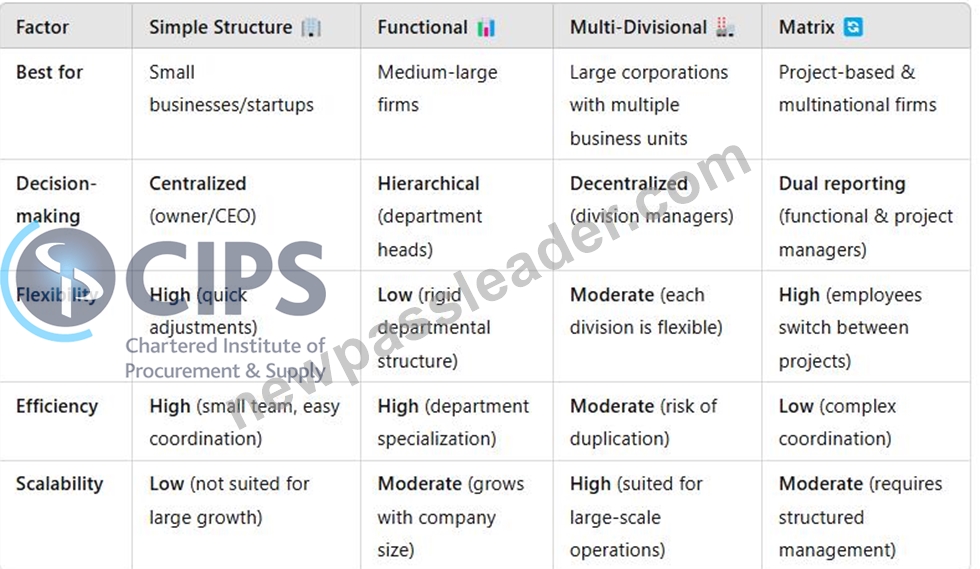
Key Takeaway: The choice of business structure depends on company size, industry, and strategic objectives.
Conclusion
Each business structure offers unique benefits and challenges:
✅ Simple Structure - Best for small, agile businesses but lacks scalability.
✅ Functional Structure - Encourages efficiency and specialization but creates departmental silos.
✅ Multi-Divisional Structure - Ideal for large firms with diverse product lines but can be costly.
✅ Matrix Structure - Encourages collaboration and flexibility but is complex to manage.
Organizations must select a business structure that aligns with their strategic goals, operational needs, and industry requirements.
NEW QUESTION # 27
......
Powerful L6M2 PDF Dumps for L6M2 Questions: https://www.newpassleader.com/CIPS/L6M2-exam-preparation-materials.html
2025 Realistic L6M2 Dumps Exam Tips Test Pdf Exam Material: https://drive.google.com/open?id=1TxWoujNT8gyEPig9J9uBye2ILvTVjDzs