

[Mar 03, 2026] Fully Updated Free Actual Microsoft GH-900 Exam Questions
Free GH-900 Questions for Microsoft GH-900 Exam [Mar-2026]
NEW QUESTION # 40
Which of the following best describes a Codespace?
- A. A development environment hosted in the cloud
- B. An AI pair programmer that offers autocomplete-style suggestions
- C. A Visual Studio Code plug-in to manage local devcontainers
- D. A lightweight editing experience that runs entirely in your browser
Answer: A
Explanation:
A Codespace is a cloud-hosted development environment provided by GitHub. It allows developers to code in a fully-configured environment that can be accessed from any device with an internet connection. Codespaces integrate with Visual Studio Code, either through the desktop app or directly in the browser, providing a consistent development experience without the need to manually set up a local environment.
Cloud-Hosted Development Environment:
Option C is correct because GitHub Codespaces are essentially cloud-based environments that are pre-configured with the tools and dependencies needed for development. This allows developers to start coding immediately without the overhead of setting up a local environment.
NEW QUESTION # 41
What is the primary purpose of creating a security policy in a repository?
- A. To describe how security vulnerabilities should be responsibly disclosed
- B. To customize the repository ' s Dependabot configuration
- C. To ensure that peer code review occurs before new changes are merged
- D. To define which types of secrets are blocked with push protection
Answer: A
Explanation:
The primary purpose of creating a security policy in a GitHub repository is to guide users and contributors on how to report security vulnerabilities in a responsible and secure manner. This policy outlines the preferred method of communication, timelines, and any other pertinent information related to handling security issues.
* Security Policy:
* Option C is correct because a security policy provides guidelines for responsibly disclosing security vulnerabilities. This helps maintainers respond to and address security concerns promptly and securely, thereby protecting the project and its users.
* Incorrect Options:
* Option A is incorrect because ensuring peer code review is a best practice for code quality, but it is not the primary purpose of a security policy.
* Option B is incorrect because push protection for secrets is managed through repository settings, not the security policy.
* Option D is incorrect because customizing Dependabot configuration is related to dependency management, not directly to security policies.
References:
GitHub Docs: Adding a Security Policy to Your Repository
NEW QUESTION # 42
Which of the following attributes are on the Milestone page? (Each correct answer presents a complete solution. Choose two.)
- A. a list of the open and closed issues associated with the milestone
- B. a summary list of GitHub Projects tagged to the milestone
- C. GitHub Action workflows that need to be executed to complete the milestone
- D. each milestone ' s completion percentage
Answer: A,D
NEW QUESTION # 43
From the Organization settings, which restrictions can organization owners place on GitHub Actions usage?
(Each answer presents a complete solution. Choose three.)
- A. Allow actions that use self-hosted runners.
- B. Allow actions by Marketplace verified creators.
- C. Allow actions created by GitHub.
- D. Allow an action to be run from a Codespace.
- E. Allow specified actions.
Answer: A,B,E
Explanation:
Organization owners on GitHub have control over how GitHub Actions can be used within their organization.
They can enforce restrictions to ensure security and compliance with organizational policies.
* Allow Actions That Use Self-Hosted Runners:
* Option A is correct because organization owners can configure the usage of self-hosted runners, allowing greater control over the environment where actions are run.
* Allow Specified Actions:
* Option C is correct because organization owners can allow only specific actions to run, adding a layer of security by limiting actions to those that have been vetted.
* Allow Actions by Marketplace Verified Creators:
* Option D is correct because organization owners can choose to allow actions created by GitHub Marketplace verified creators, ensuring that only trusted actions are used.
* Incorrect Options:
* Option B is incorrect because GitHub Actions are not designed to be run directly from a Codespace; Codespaces are for development environments.
* Option E is a valid choice, but since the prompt asks for only three answers, it is not included in this response.
References:
GitHub Docs: Managing GitHub Actions Settings for Your Organization
NEW QUESTION # 44
Workflows can reference actions in:
(Each correct answer presents a complete solution. Choose three.)
- A. An enterprise marketplace.
- B. A published Docker container image on Docker Hub.
- C. GitHub Packages.
- D. Any public repository.
- E. The same repository as your workflow file.
Answer: B,D,E
Explanation:
As mentioned in the answer to Question no. 66, GitHub Actions workflows can reference actions from a variety of sources:
Any Public Repository:
Option A is correct. Actions can be sourced from any public GitHub repository.
The Same Repository as Your Workflow File:
Option B is correct. Actions within the same repository as the workflow file can be referenced directly.
A Published Docker Container Image on Docker Hub:
Option E is correct. Workflows can also use actions provided as Docker container images from Docker Hub.
Incorrect Options:
Option C and D are not relevant for directly referencing actions in workflows.
Reference:
GitHub Docs: Reusing Workflows
NEW QUESTION # 45
Workflows can reference actions in:
(Each correct answer presents a complete solution. Choose three.)
- A. An enterprise marketplace.
- B. A published Docker container image on Docker Hub.
- C. GitHub Packages.
- D. Any public repository.
- E. The same repository as your workflow file.
Answer: B,D,E
Explanation:
In GitHub Actions workflows, actions can be referenced from various sources depending on the needs of the workflow.
* Any Public Repository:
* Option A is correct. Actions can be referenced from any public GitHub repository, allowing the reuse of shared actions across multiple projects.
* The Same Repository as Your Workflow File:
* Option B is correct. Actions stored in the same repository as the workflow file can be referenced directly, which is common for custom actions specific to that project.
* A Published Docker Container Image on Docker Hub:
* Option E is correct. Workflows can reference actions that are provided as Docker container images hosted on Docker Hub, allowing integration of complex tools and environments.
* Incorrect Options:
* Option C (GitHub Packages) is incorrect as it is more commonly used for storing and managing dependencies, not actions.
* Option D (An enterprise marketplace) is incorrect because GitHub Actions are not directly referenced from an enterprise marketplace but rather from public repositories or Docker images.
References:
GitHub Docs: Reusing Workflows
NEW QUESTION # 46
Which of the following steps are part of the Codespaces lifecycle? (Choose three.)
- A. Rebuild
- B. Create
- C. Install
- D. Clone
- E. Delete
- F. Rollback
- G. Commit
Answer: A,B,E
Explanation:
The Codespaces lifecycle on GitHub includes several key steps:
Create: This is the step where a new Codespace is initiated.
Rebuild: A Codespace can be rebuilt to ensure that the environment is up-to-date with the latest code or configurations.
Delete: Once a Codespace is no longer needed, it can be deleted to free up resources.
Committing, cloning, or installing are typical Git operations but are not considered part of the specific lifecycle steps for a GitHub Codespace.
NEW QUESTION # 47
When making comments in GitHub, the supported text language is:
- A. XML
- B. JavaScript.
- C. Markdown
- D. CSS.
- E. JSON.
Answer: C
NEW QUESTION # 48
Which of the following best describes GitHub flow?
- A. A strict workflow that enforces a linear development process with all changes made directly on the main branch
- B. A strategy where separate branches are created for each release, and pull requests are used to collaborate on and approve releases
- C. A branching model that uses feature branches and multiple primary branches
- D. A lightweight workflow that allows for safe experimentation with new ideas and collaboration on projects through branching, pull requests, and merging
Answer: D
Explanation:
GitHub Flow is a simple, yet powerful, branching strategy that is widely used in modern software development. It emphasizes collaboration and flexibility.
GitHub Flow:
Option C is correct because GitHub Flow is a lightweight workflow designed for safe experimentation and collaboration. It involves creating branches for new features or fixes, opening pull requests for review, and merging changes back into the main branch after approval.
Incorrect Options:
Option A is incorrect because GitHub Flow uses a single main branch, not multiple primary branches.
Option B is incorrect because GitHub Flow is not specifically designed around releases; it is more focused on continuous development and integration.
Option D is incorrect because GitHub Flow is not strict or linear; it encourages branching and pull requests rather than direct changes on the main branch.
Reference:
GitHub Docs: Understanding the GitHub Flow
GitHub Guides: The GitHub Flow
NEW QUESTION # 49
Which of the following can be performed within GitHub Desktop?
- A. Integrating with office suite software
- B. Creating and managing issues
- C. Reviewing and approving pull requests
- D. Commenting on discussions
- E. Adding and cloning repositories
Answer: E
Explanation:
GitHub Desktop is a graphical interface that allows users to interact with GitHub repositories. It simplifies certain Git operations without the need for command-line usage.
GitHub Desktop Capabilities:
Option C is correct because GitHub Desktop allows users to add local repositories to their GitHub account, clone repositories from GitHub to their local machine, and manage repositories effectively.
NEW QUESTION # 50
What are advantages of GitHub Projects over GitHub Projects Classic?
(Each answer presents a complete solution. Choose two.)
- A. GitHub Projects has multiple layout views.
- B. GitHub Projects are Copilot enabled.
- C. GitHub Projects has Insights.
- D. GitHub Projects can be connected to third-party tools.
Answer: A,C
Explanation:
GitHub Projects is a newer, more powerful version of project management within GitHub, offering enhanced features over the classic version.
Multiple Layout Views:
Option A is correct because GitHub Projects supports multiple views, such as board, table, and timeline views, allowing users to visualize their work in different ways according to their needs.
Insights:
Option B is correct because GitHub Projects provides insights and analytics, enabling teams to track progress and make data-driven decisions.
Incorrect Options:
Option C is incorrect because while GitHub Copilot is a tool for code suggestions, it is not directly integrated with GitHub Projects as a feature.
Option D is incorrect because both GitHub Projects and GitHub Projects Classic can be connected to third-party tools, so it is not an exclusive advantage of the newer GitHub Projects.
Reference:
GitHub Docs: Managing Projects
NEW QUESTION # 51
What is the purpose of GitHub Sponsors?
- A. It allows the developer community to financially support open source projects.
- B. It funds the most popular open source projects based on stars.
- C. It provides a channel for GitHub to support open source projects.
- D. It offers a way for companies to purchase software on GitHub.
Answer: A
NEW QUESTION # 52
Which of the following features does GitHub provide to enhance collaboration within teams?
- A. git repositories hosting and sharing capabilities
- B. code review and discussion through issues and pull requests
- C. automated testing and code quality analysis
- D. real-time collaboration through pair programming
Answer: B
Explanation:
GitHub enhances collaboration by offering features such as pull requests, issue tracking, and discussions, making it easier for remote teams to work together.
Collaborating with pull requests
Track and discuss changes in issues, then propose and review changes in pull requests.
Reference:
https://docs.github.com/en/pull-requests/collaborating-with-pull-requests
NEW QUESTION # 53
The difference between GitHub Desktop and github.com is that Desktop:
- A. Is only available on Windows operating systems.
- B. Offers a graphical user interface.
- C. Is a standalone software application.
- D. Enables integration with office suite applications.
- E. Is a self-hosted version of GitHub.
Answer: B
Explanation:
GitHub Desktop is a standalone application that provides a graphical user interface (GUI) for interacting with GitHub repositories, as opposed to the command-line or web-based interfaces available on github.com.
Graphical User Interface:
Option D is correct because GitHub Desktop offers a GUI, making it easier for users to manage repositories, perform commits, and handle other Git-related tasks without needing to use the command line.
NEW QUESTION # 54
What best describes Markdown?
- A. Version control system
- B. Containerization solution
- C. Scripting language
- D. Programming language
- E. Markup language
Answer: E
Explanation:
Markdown is a lightweight markup language with plain-text formatting syntax. It is designed to be easy to write and read in its raw form, and it can be converted into HTML and other formats. Markdown is commonly used for formatting readme files, writing messages in online discussion forums, and creating rich text documents.
Markup Language:
Option A is correct because Markdown is indeed a markup language. It is not a programming language, scripting language, version control system, or containerization solution.
Incorrect Options:
Option B is incorrect because Markdown is not a programming language; it does not involve control structures or variables.
Option C is incorrect because Markdown is not used for scripting or automation.
Option D is incorrect because Markdown does not manage version control.
Option E is incorrect because Markdown is not related to containerization technologies like Docker.
Reference:
GitHub Docs: Basic writing and formatting syntax
NEW QUESTION # 55
Which of the following items can you customize for an individual Codespace? (Choose three.)
- A. Default editor
- B. Operating system
- C. Name
- D. Shell
- E. Branch protections
Answer: A,C,D
Explanation:
When using GitHub Codespaces, you can customize several aspects of the development environment:
Shell: You can choose the default shell to be used in the Codespace, such as Bash, Zsh, or PowerShell.
Name: Users can customize the name of their Codespace for easier identification.
Default editor: You can choose which editor to use within the Codespace, such as Visual Studio Code or others that may be supported.
Branch protections and the operating system are not customizable for an individual Codespace within GitHub, making the options Shell, Name, and Default editor the correct answers.
NEW QUESTION # 56
What is the difference between Git and GitHub?
- A. Git and GitHub are different names for the same tool that is used for version control and collaboration.
- B. Git is a cloud-based hosting service, while GitHub is a distributed version control system.
- C. Git is a centralized version control system, while GitHub is a cloud-based collaboration platform
- D. Git is a command-line tool for tracking file changes, while GitHub is a platform for collaborating on Git repositories.
Answer: D
Explanation:
About GitHub and Git
About GitHub
GitHub is a cloud-based platform where you can store, share, and work together with others to write code.
Storing your code in a "repository" on GitHub allows you to:
Showcase or share your work.
Track and manage changes to your code over time.
Let others review your code, and make suggestions to improve it.
Collaborate on a shared project, without worrying that your changes will impact the work of your collaborators before you're ready to integrate them.
Collaborative working, one of GitHub's fundamental features, is made possible by the open- source software, Git, upon which GitHub is built.
About Git
Git is a version control system that intelligently tracks changes in files. Git is particularly useful when you and a group of people are all making changes to the same files at the same time.
Reference:
https://docs.github.com/en/get-started/start-your-journey/about-github-and-git
NEW QUESTION # 57
Which of the following GitHub features supports Polling?
- A. Issues
- B. Projects
- C. Wikis
- D. Discussions
Answer: D
Explanation:
Discussions Polls
Polls are available on GitHub Discussions! Polls make it easy for community members to gauge interest, vote, and interact with one another without having to comment.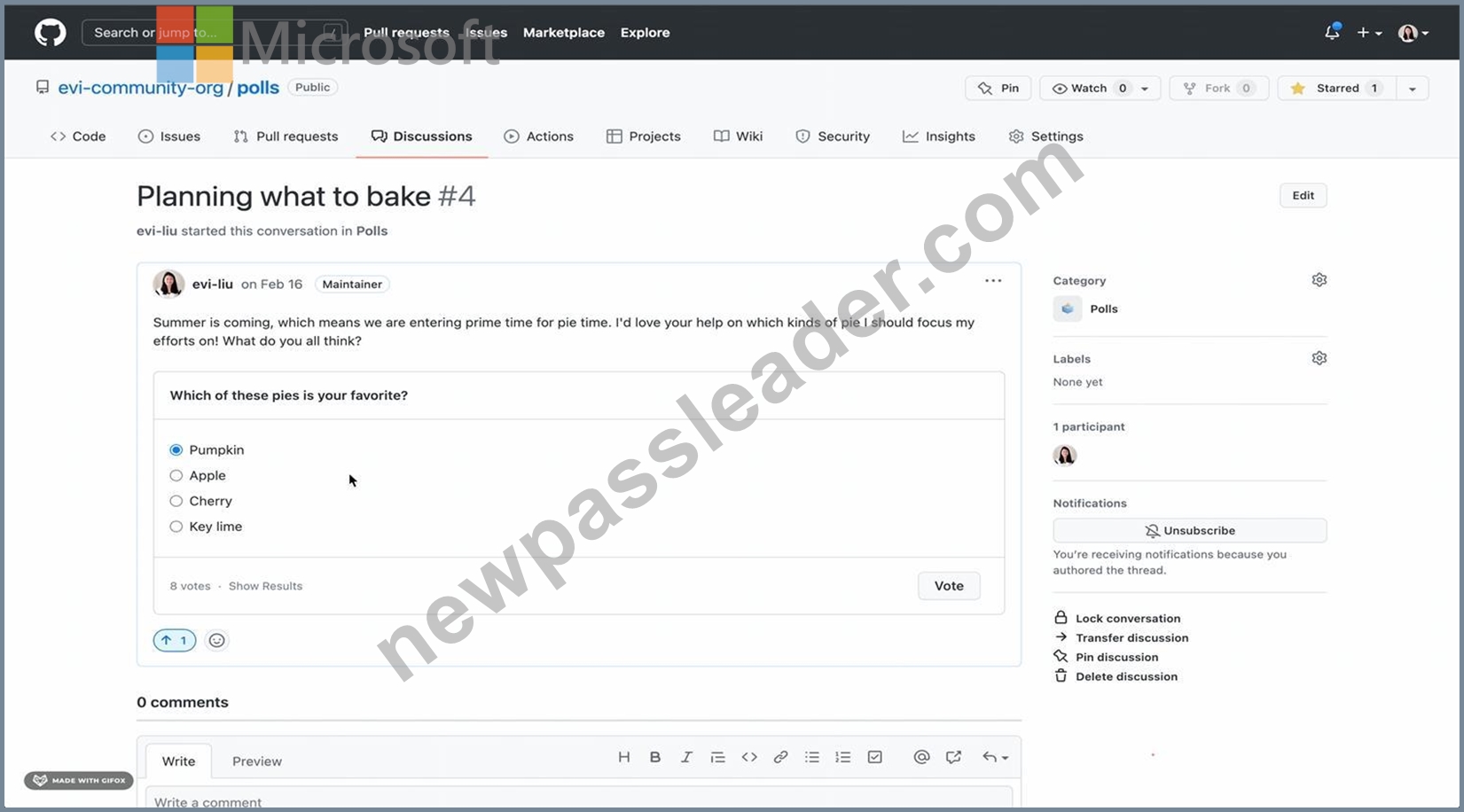
NEW QUESTION # 58
Which of the following describes a branch in Git?
- A. A separate, isolated copy of the project ' s codebase
- B. A pointer to an identical snapshot of the project at a specific point in time
- C. A new repository that shares code with the original " upstream " repository
- D. A physical copy of the entire project stored on disk
Answer: A
Explanation:
In Git, a branch is a fundamental concept that represents an independent line of development within a project.
Here ' s a more detailed explanation:
* Branch in Git:
* Option C is correct because a branch in Git is essentially a separate, isolated copy of the project ' s codebase where you can make changes without affecting the main codebase. Branches allow developers to work on features, fixes, or experiments in parallel to the main project.
* Other Options:
* Option A is incorrect because while a branch does point to a specific commit (which represents a snapshot of the project), the description lacks the emphasis on the isolated and parallel development aspect that is critical to the understanding of branches.
* Option B is incorrect because a branch is not a physical copy stored on disk; it is a logical reference within the repository.
* Option D is incorrect because that description better fits the concept of a fork, not a branch. A fork is a new repository that is a copy of another repository, usually used to contribute back to the original ( " upstream " ) repository.
References:
Git Documentation: Branches in a Nutshell
GitHub Docs: Understanding the GitHub Flow
NEW QUESTION # 59
Who can be assigned to an Issue or pull request? (Choose two.)
- A. Anyone with write permissions to the repository
- B. Anyone who has a personal GitHub account
- C. Anyone who has an enterprise GitHub account
- D. Anyone who has commented on the Issue or pull request
Answer: A,D
Explanation:
In GitHub, issues and pull requests (PRs) are essential tools for managing work and collaboration in a project. Assigning individuals to these issues or PRs is a way to indicate responsibility for addressing the issue or completing the PR.
Anyone with write permissions to the repository:
Users who have write permissions to a repository can be assigned to issues and pull requests.
Write permissions allow users to push changes to the repository, create branches, and modify issues and pull requests. Assigning them to an issue or PR ensures they are recognized as responsible for the task.
Anyone who has commented on the Issue or pull request:
GitHub allows you to assign issues or pull requests to users who have already engaged with the discussion by commenting on it. This feature is particularly useful for quickly assigning tasks to those who are already involved in the conversation.
NEW QUESTION # 60
......
Microsoft GH-900 Exam Syllabus Topics:
| Topic | Details |
|---|---|
| Topic 1 |
|
| Topic 2 |
|
| Topic 3 |
|
Validate your GH-900 Exam Preparation with GH-900 Practice Test: https://www.newpassleader.com/Microsoft/GH-900-exam-preparation-materials.html
Get all the Information About Microsoft GH-900 Exam 2026 Practice Test Questions: https://drive.google.com/open?id=1xxmV7e_NJJJ78LrjLcbrhcwlihmP1SZq