

Apr 22, 2026 PASS Huawei H12-831_V1.0-ENU EXAM WITH UPDATED DUMPS
H12-831_V1.0-ENU Questions PDF [2026] Use Valid New dump to Clear Exam
NEW QUESTION # 118
Before upgrading or downgrading the system, use the "display ()" command to view the system software, backup system software, configuration files, license files, patch files, and voice files related to the current and next startup of the device.
Answer:
Explanation:
startup
NEW QUESTION # 119
The figure shows the output information on a switch.
Which of the following can be determined from the information?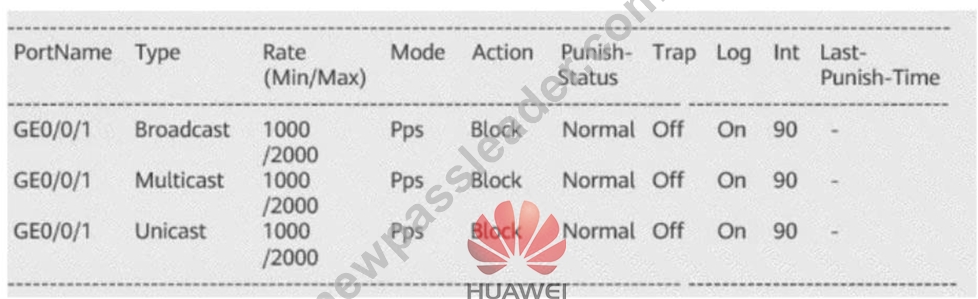
- A. When the average rate of known unicast packets is 2500 pps, GE0/0/1 is shut down.
- B. After broadcast packets are blocked on GE0/0/1, broadcast packets are forwarded only when their average rate is lower than 1000 pps.
- C. The administrator configures traffic suppression on GE0/0/1 of the switch.
- D. When the average rate of unknown multicast packets is 1500 pps, GE0/0/1 blocks the multicast packets.
Answer: C
Explanation:
Comprehensive and Detailed In-Depth Explanation:
Understanding the Table and Traffic Suppression Configuration
Port Name
Type
Rate (Min/Max)
Mode
Action
Punish-Status
Trap
Log
Int
Last-Punish-Time
GE0/0/1
Broadcast
1000 / 2000
Pps
Block
Normal
Off
On
90
-
GE0/0/1
Multicast
1000 / 2000
Pps
Block
Normal
Off
On
90
-
GE0/0/1
Unicast
1000 / 2000
Pps
Block
Normal
Off
On
90
-
Key Observations from the Table:
* Traffic suppression (or rate limiting) is configured on interface GE0/0/1 for broadcast, multicast, and unicast traffic.
* Thresholds:
* Min rate: 1000 pps (packets per second)
* Max rate: 2000 pps
* If the traffic exceeds the configured threshold (2000 pps), the action is to "Block".
* The interface is still "Normal" (not shut down), meaning exceeding 2000 pps does not disable the port.
* Logging is enabled (Log: On), but trapping (Trap: Off) is disabled.
Analysis of Each Answer Choice
A: "When the average rate of unknown multicast packets is 1500 pps, GE0/0/1 blocks the multicast packets." # (False)
* The blocking threshold for multicast is 2000 pps (Max rate).
* If the rate is 1500 pps, it is still below the threshold, so traffic is not blocked yet.
# Statement A is incorrect.
B: "When the average rate of known unicast packets is 2500 pps, GE0/0/1 is shut down." # (False)
* The table does not indicate that exceeding the max threshold (2000 pps) shuts down the interface.
* Instead, it simply blocks packets exceeding the rate limit.
* The interface remains "Normal", meaning it is not shut down.
# Statement B is incorrect.
C: "After broadcast packets are blocked on GE0/0/1, broadcast packets are forwarded only when their average rate is lower than 1000 pps." # (False)
* The minimum rate is 1000 pps, but there is no indication that traffic resumes forwarding only when it drops below this rate.
* The configuration only states blocking when exceeding 2000 pps, but does not enforce a strict reactivation at 1000 pps.
# Statement C is incorrect.
D: "The administrator configures traffic suppression on GE0/0/1 of the switch." # (True - Correct Answer)
* The table explicitly shows that a traffic suppression policy is applied to broadcast, multicast, and unicast packets on GE0/0/1.
* This confirms that the administrator has configured traffic suppression (rate limiting) on this interface.
# Statement D is correct.
Final Conclusion:
# Correct answer: D. The administrator configures traffic suppression on GE0/0/1 of the switch.
NEW QUESTION # 120
As shown in the figure, OSPF is enabled on all the routers. The IP address marked in the figure is the IP address of the loopbackO interface of the device. The LoopbackO of R1 and R2 is advertised in area 1, the LoopbackO of R4 is advertised in area 0, and the LoopbackO of R3 and R5E is advertised in area 0. In area 2, which of the following IP addresses can ping each other?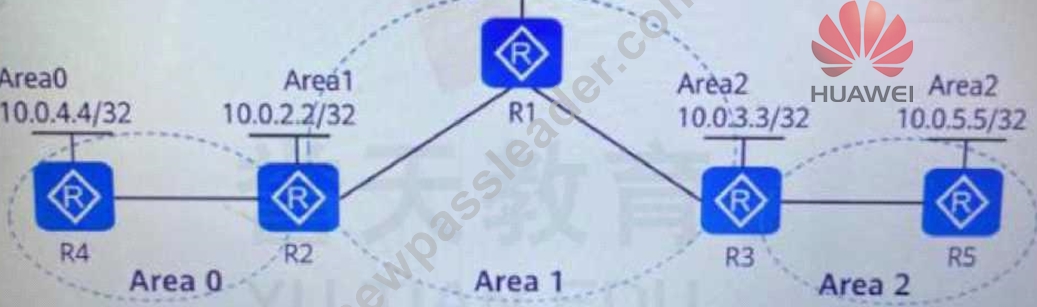
- A. 10.022and10.0.5.5 (Non-backbone area received3class received does not count)
- B. 10.0.4.4and10.022 (normal calculation3kind)
- C. 10.0.2.2and10.0.3.3 (Non-backbone area received3class received does not count)
- D. 10.0.3.3and10.0.5.5 (same area1kind)
Answer: B,D
NEW QUESTION # 121
Which of the following statements about the OSPFV3 packet format is correct?
- A. OSPFversion number from2became3
- B. HelloPackets no longer carry address informationInterface ID
- C. HellotelegramoptionNo changes to the field
- D. removedAuthentication,AuthTypefield
Answer: A,B,D
NEW QUESTION # 122
After a fault occurs, you need to collect and back up various types of fault information in time as a reference for troubleshooting. In addition, when seeking emergency assistance from Huawei Technologies Co., Ltd.
- A. False
- B. True
Answer: B
NEW QUESTION # 123
OSPF supports equal-cost load balancing. When the number of equal-cost routes in the network is greater than the number of equal-cost routes configured by the maximum load-balancing command, if the interface priority and interface index are the same, load balancing selects the route with a smaller next-hop IP address.
- A. True
- B. False
Answer: B
NEW QUESTION # 124
On the OSPFv3 network shown in the figure:
* Area 1 is a stub area, Area 2 is a common area, and Area 3 is an NSSA (Not-So-Stubby Area).
* The IPv6 address of Loopback0 on R6 is 2000::6/128.
* The router ID of each router is 10.0.X.X, where X is the router number.
* The stub no-summary command is configured in Area 1 on R2.
Which of the following statements is true?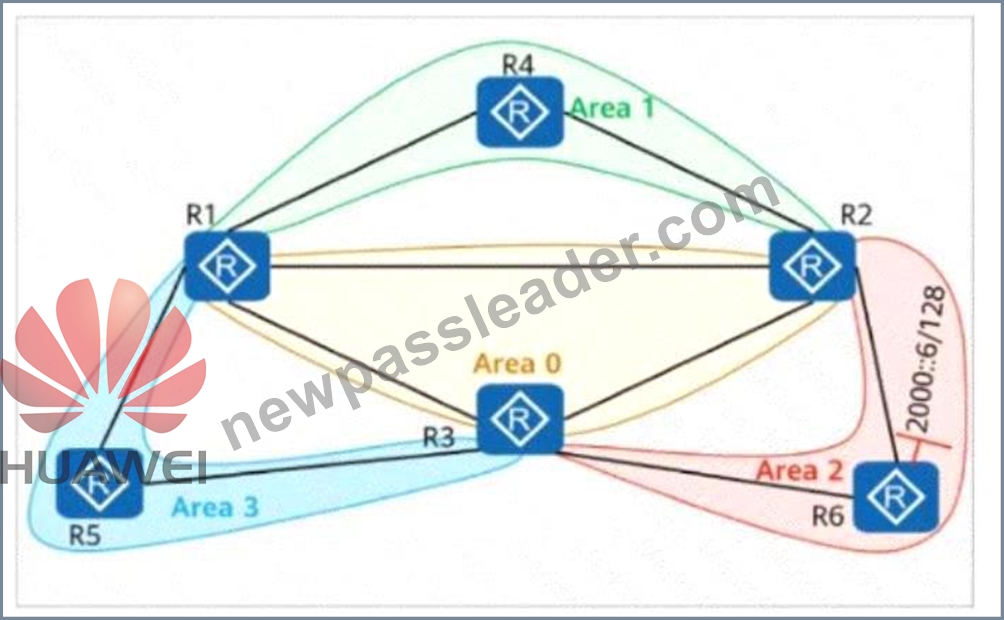
- A. The routing table of R4 does not contain the route 2000::6/128.
- B. The path for data packets from R4 to 2000::6 is R4 -> R2 -> R6.
- C. The LSDB of R4 contains the Inter-Area-Prefix-LSA that is generated by R1 and describes 2000::
6/128. - D. The path for data packets from R4 to 2000::6 is R4 -> R1 -> R5 -> R3 -> R6.
Answer: A
Explanation:
Comprehensive and Detailed In-Depth Explanation:
Understanding OSPFv3 Areas and Routing Behavior
* OSPFv3 Area Types in the Network:
* Area 1 (Stub Area): Does not accept external LSAs (Type 5) but can receive Inter-Area-Prefix- LSAs (Type 3).
* Area 2 (Common Area): Fully functional area that allows both Type 3 (Inter-Area) and Type 5 (External) LSAs.
* Area 3 (NSSA - Not-So-Stubby Area): Does not accept Type 5 (External) LSAs but allows ASBRs to inject external routes using Type 7 LSAs, which are later converted to Type 5 in other areas.
* Effect of stub no-summary Command on Area 1 (Configured on R2):
* This command prevents Type 3 LSAs from entering Area 1, meaning R4 will not learn about
2000::6/128 from other areas.
* R4 only has a default route (::/0) provided by R2 but not individual routes like 2000::6/128.
Route and Packet Flow Analysis
A: "The LSDB of R4 contains the Inter-Area-Prefix-LSA that is generated by R1 and describes 2000::6
/128." # (False)
* R4 is in Area 1 (a totally stub area), which does not receive Type 3 LSAs.
* Since 2000::6/128 is an external route from Area 2, it will not be present in R4's LSDB.
* Thus, R4 does NOT have the Inter-Area-Prefix-LSA for 2000::6/128.
# Statement A is incorrect.
B: "The path for data packets from R4 to 2000::6 is R4 -> R1 -> R5 -> R3 -> R6." # (False)
* R4 is in a totally stub area (Area 1), and it does not have a specific route for 2000::6/128.
* It only has a default route (::/0) pointing to R2.
* If R4 forwards traffic, it will send it to R2, NOT via R1, R5, and R3.
# Statement B is incorrect.
C: "The routing table of R4 does not contain the route 2000::6/128." # (True - Correct Answer)
* R4 is in a totally stub area (Area 1), meaning it only receives a default route from R2 (::/0).
* It does NOT receive specific routes like 2000::6/128.
# Statement C is correct.
D: "The path for data packets from R4 to 2000::6 is R4 -> R2 -> R6." # (False)
* While R4 does forward all unknown traffic to R2 (due to the default route), R2 will NOT directly forward to R6.
* R2 is an ABR (Area Border Router), and the actual path to 2000::6 must traverse Area 2, likely through other routers.
# Statement D is incorrect.
Final Conclusion:
# C. The routing table of R4 does not contain the route 2000::6/128.
Thus, the correct answer is: C. The routing table of R4 does not contain the route 2000::6/128.
NEW QUESTION # 125
In BGP4+, what is the content of the next hop network address field carried in the P_REA, CHLRI attribute in the Update packet?
- A. Only link-local addresses
- B. Can carry link-local addresses and global unicast addresses at the same time
- C. Can only be a global unicast address
- D. can just be a link-local address
Answer: B
NEW QUESTION # 126
After troubleshooting the problem, the network engineer wrote a troubleshooting report. He simplified the actual networking into the network shown in the figure.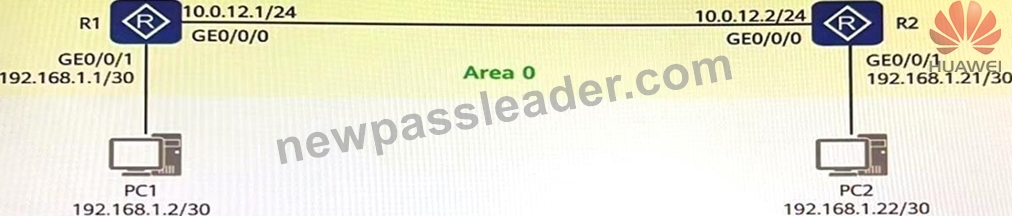
R1 and R2 both have OSPF enabled and serve as gateways for PC1 and PC2 respectively.
Which of the following descriptions are correct? (Multiple choice)
- A. PC1 and PC2 cannot ping each other.
- B. R1 can ping 192.168.1.22
- C. R2 can ping 192.168.1.2
- D. R1 can ping 192.168.1.21
Answer: B,C,D
NEW QUESTION # 127
In the IS-IS IPv6 network shown in the figure, all routers have multi-topology enabled. Configure
"ipv6 default-route-advertise always level-1" in the R4 IS-IS process.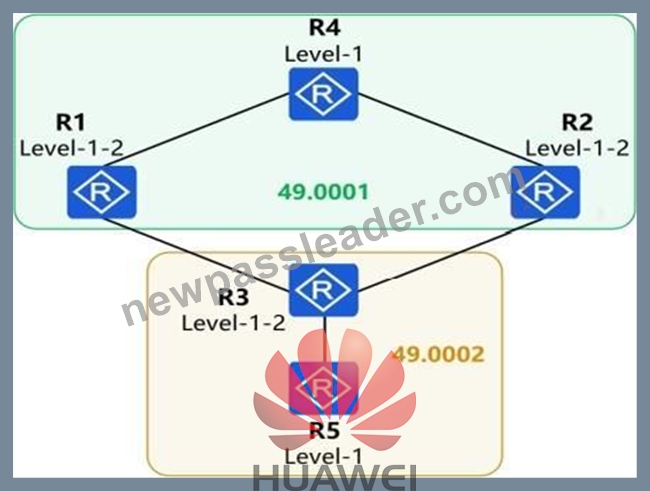
By default, which of the following routers has no default route in its routing table?
- A. R2
- B. R3
- C. R1
- D. R5
Answer: D
NEW QUESTION # 128
An interface of a switch is in error-down state. A possible cause is that the average rate of broadcast packets received by the interface exceeds the upper threshold set by the administrator for storm control.
- A. TRUE
- B. FALSE
Answer: A
NEW QUESTION # 129
The RR rules for advertising routes violate the IBGP split horizon rules, which may cause loops in the AS. Which routing attributes does RR use to prevent loops?
- A. Cluster List k
- B. AS-PATH
- C. Originator ID
- D. Nexthop
Answer: D
NEW QUESTION # 130
The ipv6 enable topology standard is configured in IS-IS protocol view. The meaning of this command is that Pv4 and IPv6 share the same topology.
- A. TRUE
- B. FALSE
Answer: A
NEW QUESTION # 131
Which of the following statements about MUX VLAN are correct? (Multiple choice)
- A. Each Separate VLAN must be bound to a Principal VLAN
- B. Separate VLAN can communicate with all VLANs in MUX VLAN
- C. Principal VLAN can communicate with all VLANs in MUX VLAI
- D. Each Group VLAN must be bound to a Principal VLAN
Answer: A,C,D
NEW QUESTION # 132
There is the concept of forwarding equivalence class FEC in MPLS, which of the following description is wrong? (Multiple choice)
- A. A forwarding equivalence FEC will be assigned a unique label value on all routers
- B. The division of FEC is very flexible. It can be based on any combination of source address, address, source port, destination port, protocol type or VPN, etc.
- C. MPLS classifies packets with the same forwarding processing method into one category, which is called FEC
- D. The packets of the same FEC will be treated differently in the MPLS network
Answer: A,D
NEW QUESTION # 133
Which of the following is not included in the OSPF Hello message?
- A. Router ID
- B. Process ID
- C. Area ID
- D. Network Mask
Answer: B
NEW QUESTION # 134
The AS-path attribute is a private attribute of the BGP protocol. The "if-match as- path-filter" command is only valid for BGP routes.
- A. False
- B. True
Answer: B
NEW QUESTION # 135
On a PIM-SM multicast network, a network engineer finds that multicast clients cannot receive multicast dat a. Which of the following is not a possible cause of this problem?
- A. The unicast routes from multicast devices to the RP are unavailable.
- B. The downstream interfaces of multicast devices do not receive any (*, G) Join messages.
- C. The RP addresses of multicast devices are different.
- D. Downstream interfaces of multicast devices are disabled from forwarding State-Refresh messages.
Answer: D
NEW QUESTION # 136
As shown in the figure, SF is enabled on all interfaces of the router, the cost value of the link is marked in the figure, and the Loopback0 interface of R2 is advertised in area 1, then the cost value of R1 reaching 10.0.2.2/32 is?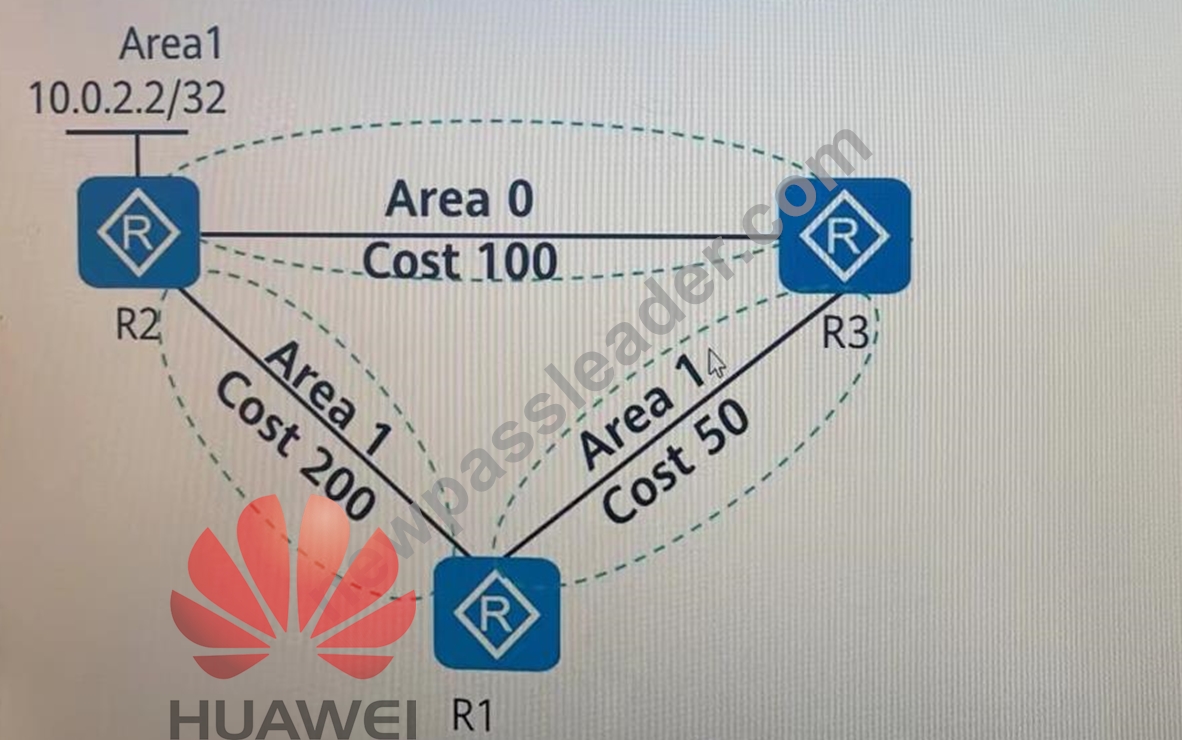
- A. 0
- B. 1
- C. 2
- D. 3
Answer: C
NEW QUESTION # 137
In BGP/MPLS IP VPN, the OSPF multi-instance process uses the DN bit to prevent Type5 LSA loops.
- A. TRUE
- B. FALSE
Answer: B
NEW QUESTION # 138
In the OSPFv3 network shown in the figure, area 1 is a stub area, area 2 is a common area, and area 3 is an NSSA area. The IPv6 address of the R5 Lopback0 interface is 2000::5/128, which is introduced into OSPFv3 through import. The Router ID of each device is 10.0.XX, where X is the device number.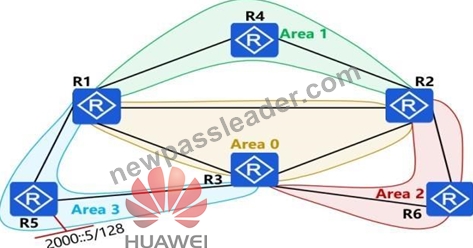
Which of the following descriptions is correct?
- A. R3 generates an Inter-Area-Router-LSA in Area 3
- B. R1 generates an Inter-Area-Router-LSA in area 0
- C. R2 generates an Inter-Area-Router-LSA in area 0
- D. R3 generates an Inter-Area-Router-LSA in Area 0
Answer: C
NEW QUESTION # 139
Which of the following functions will affect BGP neighbor establishment? (Multiple choice)
- A. BGP authentication
- B. BGP GSTM
- C. BGP route filtering
- D. ebgp max hop
Answer: A,B,D
NEW QUESTION # 140
The MPLS architecture consists of the control plane and forwarding plane, each of which contains multiple protocols and entries.
Which of the following tables is used to forward MPLS labeled packets?
- A. RIB
- B. FIB
- C. LIB
- D. LFIB
Answer: D
NEW QUESTION # 141
According to this picture, what can we know? (Multiple choice)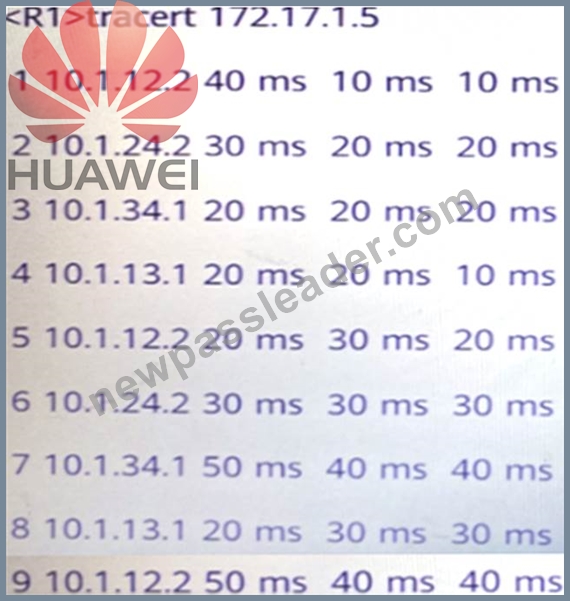
- A. R1 has a route to 172.17.1 5
- B. R1 access 172.17.1.5 has a loop
- C. R1 accesses the path of 172.17.1.5 without any problems
- D. R1 does not access the route of 172.17.1.5
Answer: A,B
NEW QUESTION # 142
Which of the following are static information coke analysis?
- A. Packet loss rate
- B. Equipment type
- C. License
- D. Interface Type
Answer: B,C,D
NEW QUESTION # 143
......
H12-831_V1.0-ENU Study Guide Brilliant H12-831_V1.0-ENU Exam Dumps PDF: https://www.newpassleader.com/Huawei/H12-831_V1.0-ENU-exam-preparation-materials.html
Passing Huawei H12-831_V1.0-ENU Exam Using 2026 Practice Tests: https://drive.google.com/open?id=1MaFurskOLOn04gdIYOa8bPhTEDsrhMZm