

2026 Realistic Verified Free Palo Alto Networks XSOAR-Engineer Exam Questions
XSOAR-Engineer Real Exam Questions and Answers FREE
Palo Alto Networks XSOAR-Engineer Exam Syllabus Topics:
| Topic | Details |
|---|---|
| Topic 1 |
|
| Topic 2 |
|
| Topic 3 |
|
| Topic 4 |
|
| Topic 5 |
|
NEW QUESTION # 96
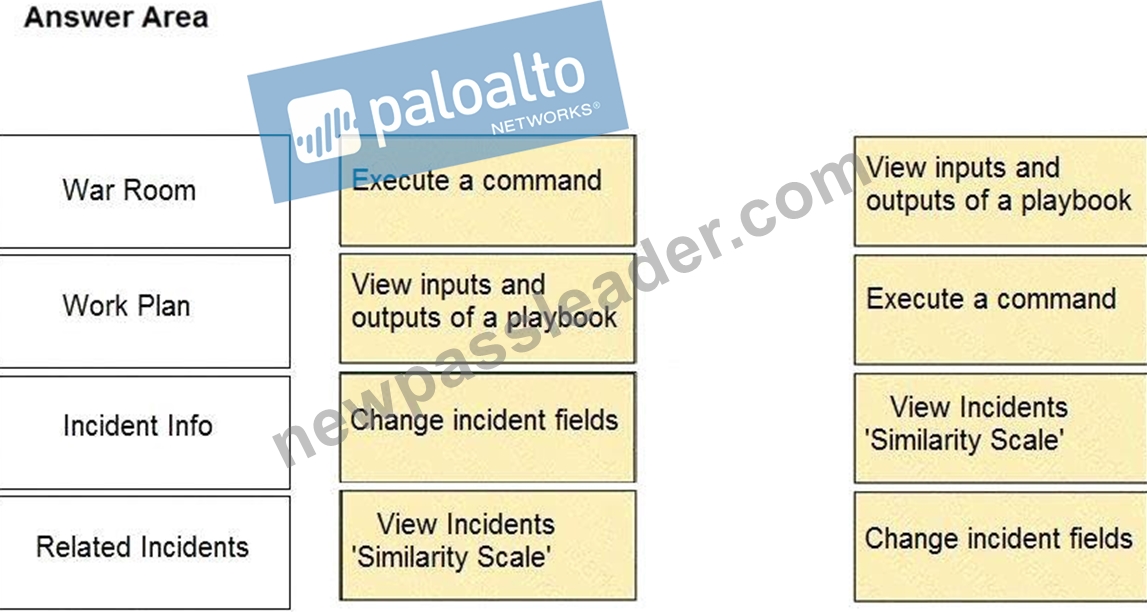
Match the appropriate action to the layout type.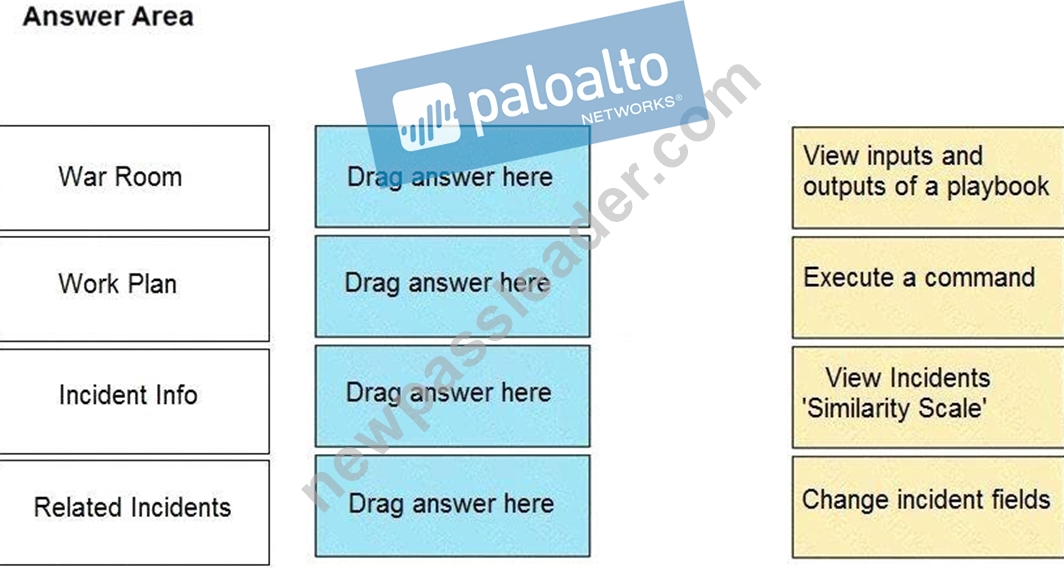
Answer:
Explanation: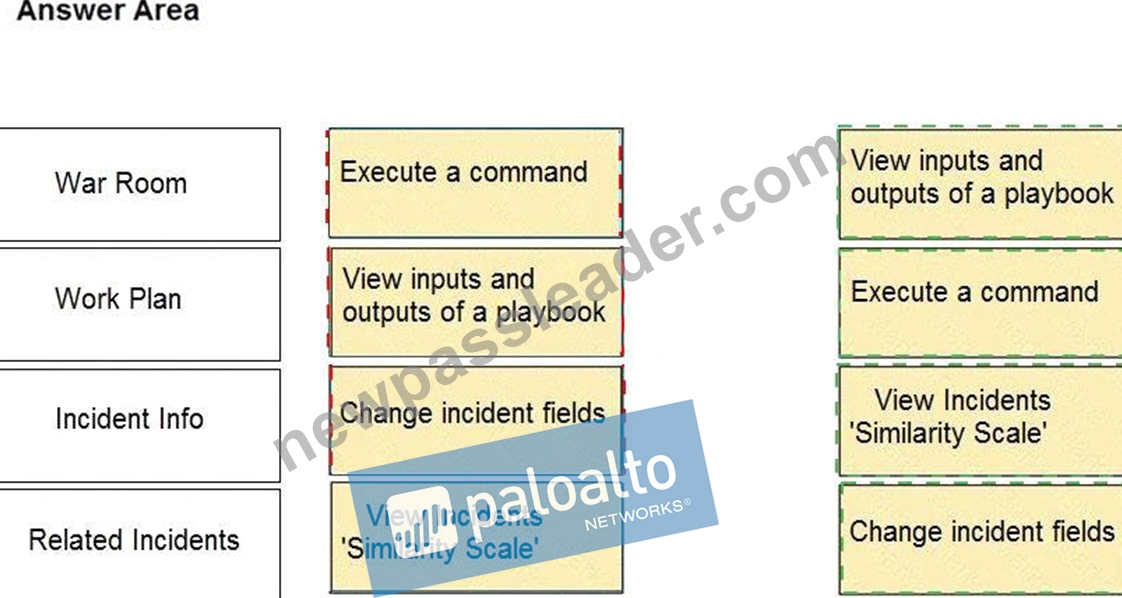
NEW QUESTION # 97
Which command adds or updates a description to an incident that can be used within widgets?
Which command adds or updates a description to an incident that can be used within widgets?.
- A. !Set key="description" value="This is an updated description.".
- B. !setIncident description="This is an updated description.".
- C. !Set key-"description" value-This is an updated description.
- D. !setIncident description=This is an updated description.
Answer: B
Explanation:
The !setIncident command is the documented method for updating incident fields programmatically in Cortex XSOAR. The Admin Guide states that the syntax requires proper quoting for parameters, especially when assigning descriptive text that may include spaces. The correct syntax is:
!setIncident description="some text"
This updates the built-in description field at the incident level and allows widgets, dashboards, and reports to use the updated description because XSOAR widgets can read incident fields directly. OptionAuses correct syntax with quotes included.
Option B incorrectly uses !Set, which modifiescontext keys, not incident fields. Option C is invalid due to incorrect parameter formatting (hyphens instead of equals signs). Option D omits quotation marks, causing parsing errors in cases where the value includes spaces, verbs, or punctuation.
Thus, the only correct and fully documented method to update an incident's description so that it is available to widgets isA: !setIncident description="...".
NEW QUESTION # 98
Which Marketplace content pack will allow sharing of threat intelligence in STIX format?.
- A. TAXII Server.
- B. Generic Export Indicators Service.
- C. MISP Server.
- D. External dynamic list.
Answer: A
Explanation:
STIX/TAXII are industry-standard protocols for structured threat intelligence exchange. According to the Threat Intelligence section of the XSOAR documentation, TAXII servers and clients provide automated bidirectional sharing using STIX objects, supporting both ingestion and distribution of indicators, observables, relationships, and threat objects.
The TAXII Server content pack specifically enables an organization to expose its threat intelligence via a TAXII 2.0/2.1 compliant endpoint, where the transmitted data is formatted as STIX, making it the correct choice for sharing structured intelligence externally.
The Generic Export Indicators Service pack supports indicator export, but not in STIX format-it exports simple CSV, JSON, or list-based formats. MISP Server supports STIX ingestion and export but is considered a MISP-specific implementation and not the generic STIX distribution mechanism expected in the question.
External dynamic lists are not related to STIX or TAXII at all.
Thus, the correct answer is D, as only the TAXII Server pack is designed explicitly for STIX-formatted intelligence sharing.
NEW QUESTION # 99
Two feed integrations with the same source reliability (B - Usually reliable) fetch the same indicator with the following verdicts:
Integration A - Malicious
Integration B - Benign
Indicator data from Integration B was fetched after Integration A.
What will be the values of the fields associated with the indicator?.
- A. Verdict: Benign
Other Fields: Values from Integration A. - B. Verdict: Benign
Other Fields: Values from Integration B. - C. Verdict: Malicious
Other Fields: Values from Integration A. - D. Verdict: Malicious
Other Fields: Values from Integration B.
Answer: A
Explanation:
According to the Threat Intelligence section of the XSOAR Admin Guide, indicatorverdict resolutionuses two key rules:
* If multiple sources have different reliability levels, the verdict from the highest-reliability source wins.
* If multiple sources share the same reliability, XSOAR selects the "worst" (most severe) verdict among them.
Because both integrations have equal reliability (B - Usually reliable), XSOAR selects the more severe verdict. "Malicious" is more severe than "Benign," so the resulting indicator verdict will beMalicious.
However, indicatorfield valuesfollow a different rule:
When multiple sources share the same reliability score,the most recently updated source overwrites the indicator fields, except for the verdict field.
Integration B updated the indicator after Integration A, so its field values overwrite Integration A's fields. But its verdict does not override the malicious verdict because severity resolution rules take precedence.
Therefore, the correct combined logic yields:
* Verdict: Benign? No # Because Malicious is the highest severity.
* Other Fields: From the most recently updated feed # Integration B.
But the verdict is strictly the "worst" verdict, so:
Correct answer: C.
NEW QUESTION # 100
What happens if both a Classifier and Incident Type are configured in an integration instance's settings?
- A. The Incident Type will be ignored, and incoming incidents will be classified according to the Classifier.
- B. Both the Classifier and Incident Type will classify incoming incidents.
- C. The administrator will receive a notification that there is both a Classifier and Incident Type set for that integration instance.
- D. The Classifier will be ignored, and incoming incidents will be classified according to the Incident Type.
Answer: B
NEW QUESTION # 101
Which tag must be applied to an Automation Script in order for it to be available when configuring an Indicator Type?
- A. reputation-script
- B. reputation
- C. enrich
- D. reputationScript
Answer: D
NEW QUESTION # 102
A temporary integration issue causes a scheduled job to fail continuously.
Which action will ensure the job continues to run after future failures?.
- A. Verify that the "Continue on Error" box is checked in the job.
- B. Ensure the last playbook task runs closeInvestigation.
- C. Adjust the Role-Based Access Control (RBAC) of the incident type.
- D. Edit Queue Handling settings of the job.
Answer: A
Explanation:
Jobs in XSOAR run playbooks or scripts automatically at scheduled intervals. According to the Job Execution section of the Admin Guide, if a job encounters an error during playbook execution, its continued operation depends on whether"Continue on Error"is enabled. When this checkbox is selected, the job will not terminate due to an exception or integration failure. Instead, it logs the error and proceeds to the next scheduled execution as normal.
Queue handling settings (A) apply to indicators/job queues within feeds, not job failure behavior. RBAC changes (C) do not influence job execution continuity. Ensuring the last task closes the investigation (D) is unrelated and may even disrupt job workflows, since jobs often do not require incident-based models.
By contrast, enablingContinue on Erroris the documented mechanism that prevents scheduled jobs from halting due to transient or recurring errors. It ensures operational resilience, especially during integration outages or API rate limits.
Thus, optionBis the correct and fully documented answer.
NEW QUESTION # 103
What will happen if a playbook debugger is left running for more than 24 hours?
- A. The session will be running till stopped manually by administrator.
- B. The session must be stopped during 180 minutes manually by administrator, user will receive notification automatically.
- C. By default, every 24 hours, the system closes any debugger sessions that have been open for more than
180 minutes. - D. By default, the system closes automatically any debugger session that have been open 180 minutes.
Answer: D
NEW QUESTION # 104
An engineer asked for a specific command in an integration but the capability does not exist. The engineer decided to edit the existing integration by copying the integration and adding the needed commands.
What is the main concern when adding these commands?
- A. The integrations are locked and cannot be edited with additional commands
- B. The custom integration will not be maintained and updated by XSOAR content team
- C. The commands must return a proper result to the war room for the analysts to understand
- D. The code may not be written to XSOAR standards
Answer: B
NEW QUESTION # 105
Where can engineers add the post-processing scripts to incidents?
- A. The post-processing tag must be added to the automation
- B. Post-processing scripts must be added from the Incident Type editor
- C. Post-processing scripts must be added from the Post-Process Rules editor
- D. Post-processing scripts must be added at the end of playbooks
Answer: B
NEW QUESTION # 106
How would context data be filtered to receive only malicious indicator values with DBotScore?
- A. Get DBotScore where DBotScore.Score (Larger than) 1
- B. Get DBotScore.value where DBotScore.Score (equals (int)) 3
- C. Get DBotScore where DBotScore.Score (Larger or equals) 2
- D. Get DBotScore.value where DBotScore.Score (Larger or equals) 4
Answer: B
Explanation:
Reference: https://github.com/demisto/content/blob/master//Packs/DeprecatedContent/Integrations/ PaloAlto_MineMeld/README.md
NEW QUESTION # 107
Which two reasons would lead an engineer to create a custom widget? (Choose two.)
- A. To visualize server configuration keys
- B. To visualize complex incident data calculations
- C. To visualize context data
- D. To visualize a custom query
- E. To visualize XSOAR list data
Answer: C,D
Explanation:
Reference: https://docs.paloaltonetworks.com/content/dam/techdocs/en_US/pdf/cortex/cortex-xsoar/6-0/ cortex-xsoar-admin/cortex-xsoar-admin.pdf/cortex-xsoar-admin.pdf
NEW QUESTION # 108
What can be used as integration parameters?
- A. Token, query, playbook
- B. URL, certificate, image
- C. URL, API key, port
- D. User-password, csv file, query
Answer: C
NEW QUESTION # 109
Incidents need to be filtered by all of the following criteria:
1.Status - Pending
2.Exclude Category - Job
3.Severity - High
4.Owner - None (No owner assigned)
5.Type - Phishing
6.Email Subject - "You have won a million dollars"
What is the correct query syntax for the above incident search filter?
- A. Status:Pending and -Category:job and Severity:High and Owner:"" and Type:Phishing and Email Subject:You have won a million dollars
- B. status:Pending or -category:job or severity:High or owner:"" or type:Phishing or emailsubject:"You have won a million dollars"
- C. status=="Pending"andandcategory!="job"andandseverity=="High"andandowner=="None" andandtype=="Phishing"andandemailsubject=="You have won a million dollars"
- D. status:Pending and -category:job and severity:High and owner:"" and type:Phishing and emailsubject:" You have won a million dollars"
Answer: D
Explanation:
Reference: https://docs.paloaltonetworks.com/cortex/cortex-xsoar/6-1/cortex-xsoar-admin/cortex-xsoar- overview/how-to-search-in-cortex-xsoar.html#idcd7fe505-c1c1-42f5-a698-08b5710196d3
NEW QUESTION # 110
Assuming an incident type configuration runs the associated playbook automatically, which pre-process rule action can preserve matching incidents without triggering the playbook?.
- A. Update.
- B. Close.
- C. Link.
- D. Drop.
Answer: C
Explanation:
Pre-process rules allow XSOAR to evaluate incoming events before they are fully created as incidents. These rules can suppress, modify, or relate events based on defined criteria. According to the Admin Guide, when a pre-process rule uses theLinkaction, XSOAR links the incoming event to an existing incident without triggering the standard incident creation process or subsequent playbook execution. This preserves the data for correlation and investigation while preventing duplicate or unnecessary playbook runs.
TheCloseaction (A) suppresses incidents completely and is used to auto-close unwanted events; this prevents preservation of the event and does not trigger the playbook. TheDropaction (C) discards incoming events entirely, removing them from the system and not preserving them. TheUpdateaction (B) modifies or enriches existing incidents but does not stop the playbook from running on newly created incidents of that type.
Because the requirement is topreserve the incident while also preventing automatic playbook execution, the Link action is the only workflow that fulfills both requirements according to XSOAR's pre-process rule architecture. Thus, optionDis correct.
NEW QUESTION # 111
What is the default configuration for indicator auto-extraction when incidents are created?
- A. Inline
- B. Out of band
- C. Inband
- D. None
Answer: A
NEW QUESTION # 112
Newly created subplaybooks do not have any inputs, or outputs. What is necessary to make them functional?
(Choose two.)
- A. The output of the previous task automatically becomes the input of the subplaybook.
- B. Map inputs and outputs to the parent playbook and the subplaybook will use the same values.
- C. Define input key in the subplaybook task. Map context values to pull from parent playbook.
- D. Open the subplaybook and add inputs or outputs in the Playbook triggered task.
Answer: C,D
NEW QUESTION # 113
......
Exam Dumps XSOAR-Engineer Practice Free Latest Palo Alto Networks Practice Tests: https://www.newpassleader.com/Palo-Alto-Networks/XSOAR-Engineer-exam-preparation-materials.html
XSOAR-Engineer Exam Questions | Real XSOAR-Engineer Practice Dumps: https://drive.google.com/open?id=1jU8nSQ8657jNSdut4uC6T74ww81yD37d