

2026 Realistic C_BCBAI_2502 Dumps are Available for Instant Access
Download Exam C_BCBAI_2502 Practice Test Questions with 100% Verified Answers
SAP C_BCBAI_2502 Exam Syllabus Topics:
| Topic | Details |
|---|---|
| Topic 1 |
|
| Topic 2 |
|
| Topic 3 |
|
NEW QUESTION # 11
(What are some functions that the SAP Build Code with code generation add-on provides? Note: There are 2 correct answers to this question.)
- A. Insert code snippets through Joule
- B. Refactor CAP projects
- C. Generate unit tests for ABAP classes
- D. Explain existing code
Answer: C,D
Explanation:
Comprehensive and Detailed Explanation From Exact Extract: The SAP Build Code with code generation add-on, powered by Joule, provides functions such as explaining existing code through code reviews and comments, and generating unit tests for ABAP classes by selecting methods and using AI-based features to create tests efficiently.
Exact extracts supporting this:
Explain existing code: "/cap-edit-model: Edits existing CAP data models, supports code reviews, adds comments, and answers questions like 'Does this code follow the best practices of CAP?'"community.sap.com "/ui5: Explains UI5-related artifacts, e.g., 'What does the code in the main controller do?', with options to consider selected code without specifying files."community.sap.com "Code Commenting via Joule Code Assistant, generating explanatory comments for selected code, with accept/reject options."community.sap.com Generate unit tests for ABAP classes: "With Joule for developers, ABAP AI capabilities, you can easily access AI-based features designed to help you create ABAP Unit tests."help.sap.com "Navigate to any of the specified views and select a public method from a global ABAP class. Open the context menu and select Joule Generate Unit Tests."help.sap.com Other options are incorrect because:
Option B: While Joule supports inline code-completion for suggesting snippets, this is a general feature rather than a specific function of the code generation add-on, which focuses on broader generation tasks like models and tests rather than snippet insertion.
Option C: Refactoring is supported for CAP projects through editing models and code refactor assistants, but it is not highlighted as a primary function of the code generation add-on, which emphasizes generation and explanation over refactoring.
Reference from Positioning SAP Business AI Solutions as part of SAP Business Suite documents or Study Guide: Based on SAP Community blogs like "Overview of all GenAI Options in SAP Build Code" and "Develop with Joule in SAP Build Code," as well as SAP Help Portal documentation on ABAP AI capabilities in SAP Build Code. These align with the C_BCBAI_2502 certification, positioning SAP Build Code as an AI-enhanced development tool within the SAP Business Suite for Java, JavaScript, and ABAP.
NEW QUESTION # 12
What are some benefits of SAP Signavio's Al-assisted process analyzer, text to insights?
There are 3 correct answers to this question.
Response:
- A. Democratized approach to process mining
- B. Increased accuracy and relevance of the analysis output based on business user prompts
- C. Self-service approach to define initial process monitoring framework
- D. Correlation and anomaly detection consumable by business users
- E. No need for consulting-heavy services to define the first process draft to start the modeling activity
Answer: A,B,D
NEW QUESTION # 13
What are the key Business AI patterns? Note: There are 3 correct answers to this question.
- A. Custom Generative AI Extensions
- B. Digital Assistants with SAP
- C. Enterprise Automation
- D. AI Lifecycle Management
- E. Insight Apps, Data for AI
Answer: B,C,E
Explanation:
SAP Business AI is structured around key patterns that define how AI is applied across business processes.
The correct answers are Digital Assistants with SAP, Enterprise Automation, and Insight Apps, Data for AI, as these are explicitly documented as core Business AI patterns in SAP's framework.
SAP documentation states: "SAP Business AI is built around key patterns that enable organizations to leverage AI effectively: Digital Assistants with SAP, Enterprise Automation, and Insight Apps, Data for AI." Digital Assistants with SAP, exemplified by Joule, provide "natural language interfaces to interact with business processes," enhancing user productivity. Enterprise Automation involves "using AI-driven automation, such as SAP Intelligent RPA, to streamline repetitive tasks and optimize workflows" across functions like finance and supply chain. Insight Apps, Data for AI refers to "delivering predictive analytics and data-driven insights" through applications like SAP S/4HANA, which support decision-making with real- time data.
The incorrect options-AI Lifecycle Management and Custom Generative AI Extensions-are not listed as primary Business AI patterns. AI Lifecycle Management is a technical process for managing AI models, not a business pattern. Custom Generative AI Extensions, while emerging, are not a core pattern in SAP's current Business AI framework, which focuses on established use cases. SAP's emphasis on these patterns, as seen in its AI strategy, confirms the selected answers.
NEW QUESTION # 14
What are the benefits of SAP AI-driven predictive analytics? Note: There are 3 correct answers to this question.
- A. Automated anomaly detection
- B. Future trend forecasting
- C. Manual invoice processing
- D. Increased manual data entry
- E. Real-time decision-making insights
Answer: A,B,E
Explanation:
SAP AI-driven predictive analytics provides significant benefits by enabling organizations to anticipate trends, make informed decisions, and automate anomaly detection. The correct answers are future trend forecasting, real-time decision-making insights, and automated anomaly detection, as these are core benefits documented in SAP's AI portfolio.
SAP documentation states: "SAP Business AI offers predictive analytics to enhance decision-making, provide personalized insights, and improve business processes. It supports future trend forecasting, real-time decision- making, and automated anomaly detection across functions like finance, supply chain, and marketing." Future trend forecasting allows organizations to "predict customer demand, financial trends, and operational risks," as seen in SAP S/4HANA's forecasting of incoming payments. Real-time decision-making insights enable
"proactive responses to market changes" by analyzing live data, such as in SAP Integrated Business Planning.
Automated anomaly detection identifies "unusual patterns in financial transactions or supply chain operations," enhancing security and efficiency, as exemplified by SAP AI Business Services' fraud detection capabilities.
The incorrect options-increased manual data entry and manual invoice processing-are contrary to SAP's automation focus. Predictive analytics aims to reduce manual efforts, not increase them, and manual invoice processing is replaced by solutions like SAP Cash Application. SAP's emphasis on AI-driven automation and insights, as seen in case studies like Henkel's supply chain optimization, confirms the selected benefits.
NEW QUESTION # 15
Which key advantage does SAP Business AI provide to organizations?
Please choose the correct answer.
Response:
- A. Manual business process execution
- B. Isolated data storage without AI integration
- C. Predictive insights for decision-making
- D. Automated financial accounting processes
Answer: C
NEW QUESTION # 16
Which SAP solution helps companies ensure compliance with environmental regulations?
Please choose the correct answer.
Response:
- A. SAP Extended Warehouse Management
- B. SAP EHS
- C. SAP Business Warehouse
- D. SAP SuccessFactors
Answer: B
NEW QUESTION # 17
(What are some generative AI tools for an SAP Cloud ERP transformation? Note: There are 3 correct answers to this question.)
- A. Integration generator
- B. ABAP Business Object generator
- C. Extension builder wizard
- D. Process automation
- E. Process model generator
Answer: B,D,E
Explanation:
Comprehensive and Detailed Explanation From Exact Extract: Generative AI tools for SAP Cloud ERP transformation include process automation capabilities in SAP Build Process Automation for generating and automating business processes, the process model generator in SAP Signavio for creating process models using AI, and the ABAP Business Object generator in Joule for developing ABAP-based business objects to extend ERP functionalities. These tools facilitate efficient migration, customization, and optimization during cloud ERP transformations by leveraging generative AI to streamline code, processes, and extensions.
Exact extracts supporting this:
Process automation: "SAP Build Process Automation integrates with generative AI to generate and edit business processes, decisions, forms, and script tasks using natural language descriptions."sap.com This supports automation in ERP transformations.
Process model generator: "SAP Signavio uses generative AI to assist in process modeling, recommending performance indicators and generating models based on best practices."learning.sap.com ABAP Business Object generator: "Joule generates ABAP business objects using the ABAP RESTful Application Programming Model (RAP) for extensions in SAP S/4HANA Cloud."learning.sap.com "Generative AI in ABAP Cloud includes business object generation."community.sap.com Other options are incorrect because:
Option B: While extension building is simplified with wizards in SAP Build Code, it is not specifically a "generative AI tool" but rather a guided process; generative aspects come from Joule integration.
Option C: Integration generation is supported in SAP BTP, but not highlighted as a distinct generative AI tool for ERP transformation; focus is on code and process generation.
Reference from Positioning SAP Business AI Solutions as part of SAP Business Suite documents or Study Guide: Derived from SAP Learning Journey "Boosting Your Cloud Transformation Journey with SAP Business AI and Generative AI," units on generative AI in SAP Signavio, Build Process Automation, and ABAP Cloud. Supported by SAP Community blogs on generative AI for S/4HANA migration and SAP Help Portal, aligning with C_BCBAI_2502 certification for tools in cloud ERP transformations.
NEW QUESTION # 18
What are some benefits of SAP Signavio's AI-assisted process analyzer, text to insights? Note: There are 3 correct answers to this question.
- A. Democratized approach to process mining
- B. Increased accuracy and relevance of the analysis output based on business user prompts
- C. Self-service approach to define initial process monitoring framework
- D. Correlation and anomaly detection consumable by business users
- E. No need for consulting-heavy services to define the first process draft to start the modeling activity
Answer: A,B,D
Explanation:
SAP Signavio's AI-assisted process analyzer, particularly its text-to-insights capability, enhances process mining and optimization by making it accessible and actionable for business users. The correct answers are correlation and anomaly detection consumable by business users, democratized approach to process mining, and increased accuracy and relevance of the analysis output based on business user prompts, as these are explicitly documented benefits.
SAP documentation explains: "SAP Signavio Process Intelligence leverages AI to provide a democratized approach to process mining, enabling business users to analyze processes without deep technical expertise.
The text-to-insights feature uses natural language processing to interpret user prompts, delivering accurate and relevant analysis outputs." Specifically, it offers "correlation and anomaly detection" that is "consumable by business users," allowing them to identify process inefficiencies and outliers easily. The "democratized approach to process mining" ensures that non-technical users can engage in process analysis, reducing reliance on data scientists. Additionally, the solution provides "increased accuracy and relevance of the analysis output" by tailoring insights to user-defined prompts, enhancing decision-making.
The incorrect options-no need for consulting-heavy services and self-service approach to defineinitial process monitoring framework-are not emphasized in SAP Signavio's documentation for text-to-insights.
While SAP Signavio reduces complexity, it still requires some setup and expertise for initial process modeling, and the self-service framework is not a primary benefit of the text-to-insights feature. The focus remains on user accessibility and AI-driven insights, as seen in SAP's process optimization case studies.
NEW QUESTION # 19
A multinational company wants to implement AI-based fraud detection for its financial transactions. Which SAP AI solutions should they use? Note: There are 3 correct answers to this question.
- A. SAP Predictive Analytics
- B. SAP SuccessFactors AI
- C. SAP Cloud ERP
- D. SAP Intelligent RPA
- E. SAP AI Business Services
Answer: A,D,E
Explanation:
For a multinational company seeking AI-based fraud detection in financial transactions, SAP offers solutions that leverage machine learning and automation to identify and mitigate fraudulent activities. The correct answers are SAP AI Business Services, SAP Predictive Analytics, and SAP Intelligent RPA, as these solutions directly support fraud detection in financial processes.
SAP documentation explains: "SAP AI solutions can detect anomalies and patterns in financial transactions, procurement processes, and other business operations to identify potential fraud and risks." SAP AI Business Services provide "machine learning capabilities for fraud detection in finance," enabling real-time monitoring of transactions to identify suspicious activities. SAP Predictive Analytics, embedded in SAP S/4HANA, supports "AI-assisted anomaly detection" to "predict and identify unusual patterns in financial data," such as fraudulent transactions, enhancing security. SAP Intelligent RPA automates "transaction monitoring and validation processes," using AI to flag potential fraud by cross-referencing data against predefined rules, as seen in financial reconciliation workflows.
The incorrect options-SAP SuccessFactors AI and SAP Cloud ERP-are not relevant. SAP SuccessFactors AI focuses on HR processes, such as recruitment, not financial fraud detection. SAP Cloud ERP is a broad platform that may include AI but is not specifically tailored for fraud detection compared to the selected solutions. SAP's financial AI solutions, as evidenced by their use in SAP Cash Application, confirm the suitability of the chosen answers.
NEW QUESTION # 20
Which SAP solution provides a centralized platform for tracking sustainability performance?
Please choose the correct answer.
Response:
- A. SAP Extended Warehouse Management
- B. SAP Business One
- C. SAP Sustainability Control Tower
- D. SAP Fieldglass
Answer: C
NEW QUESTION # 21
What are the key use cases of SAP AI in manufacturing?
There are 3 correct answers to this question.
Response:
- A. AI-powered production scheduling
- B. AI-driven predictive maintenance
- C. Handwritten production reports
- D. Automated quality control
- E. Manual equipment failure analysis
Answer: A,B,D
NEW QUESTION # 22
(What are some characteristics of trustworthy business AI? Note: There are 3 correct answers to this question.)
- A. Relevance
- B. Resourcefulness
- C. Reusability
- D. Reliability
- E. Responsibility
Answer: A,D,E
Explanation:
Comprehensive and Detailed Explanation From Exact Extract: Characteristics of trustworthy business AI include responsibility through ethical governance and accountability, reliability via accurate and secure operations, and relevance by grounding in business data and contexts. These ensure AI is human-centered, transparent, and beneficial for enterprise use.
Exact extracts supporting this:
"These three "R"s - relevance, reliability, responsibility - are the cornerstones of trustworthy AI for the business world."news.sap.com Responsibility: "SAP Business AI is... responsible."learning.sap.com Reliability: "Reliable: built on best technology and partnerships."news.sap.com Relevance: "Relevant: grounded in business data."news.sap.com Other options are incorrect because:
Option B: Resourcefulness is not a defined characteristic; focus is on the three R's.
Option C: Reusability may apply to models but is not a core trustworthiness trait; emphasis is on ethics and accuracy.
Reference from Positioning SAP Business AI Solutions as part of SAP Business Suite documents or Study Guide: Derived from SAP News "Trustworthy AI Can Reinvent Companies" and SAP Learning "Introducing SAP Business Artificial Intelligence," which define trustworthy AI via relevance, reliability, and responsibility, aligned with C_BCBAI_2502 certification.
NEW QUESTION # 23
A logistics company is looking to reduce delivery delays and improve inventory management. Which SAP AI-powered solutions should they implement?
There are 3 correct answers to this question.
Response:
- A. SAP BusinessObjects Planning
- B. SAP Predictive Analytics
- C. SAP Digital Manufacturing Cloud
- D. SAP AI Business Service
- E. SAP Cloud ERP
Answer: B,C,D
NEW QUESTION # 24
A multinational company wants to implement AI-based fraud detection for its financial transactions. Which SAP AI solutions should they use?
There are 3 correct answers to this question.
Response:
- A. SAP Predictive Analytics
- B. SAP SuccessFactors AI
- C. SAP Cloud ERP
- D. SAP Intelligent RPA
- E. SAP AI Business Services
Answer: A,D,E
NEW QUESTION # 25
Which SAP AI solution helps optimize supply chain operations?
Please choose the correct answer.
Response:
- A. SAP AI Core
- B. SAP Business Workflow
- C. SAP Digital Assistant
- D. SAP AI for Supply Chain
Answer: D
NEW QUESTION # 26
(Which of the following makes SAP a trusted AI partner? Note: There are 3 correct answers to this question.)
- A. Unparalleled collaborations with leading general-purpose AI technology providers
- B. The AI use case 'Risk Classification & Assessment Process' within the SAP AI Ethics Handbook
- C. Unique access to, and understanding of, business data
- D. Commitment to data protection, privacy, security, and ethics
- E. Affirming the guiding principles of the UNESCO Recommendation on the Ethics of AI
Answer: B,D,E
Explanation:
Comprehensive and Detailed Explanation From Exact Extract: SAP is positioned as a trusted AI partner due to its strong commitment to data protection, privacy, security, and ethics, its affirmation of the UNESCO Recommendation on the Ethics of AI, and the inclusion of the 'Risk Classification & Assessment Process' as an AI use case in the SAP AI Ethics Handbook, which ensures structured risk reviews and ethical AI development.
Exact extracts supporting this:
Commitment to data protection, privacy, security, and ethics: "SAP's AI Ethics efforts are guided by a multi-stakeholder approach and a strong governance framework, coordinated by the AI Ethics Office. The approach is based on SAP's Global AI Ethics Policy and development standards for responsible AI innovation... Principles include proportionality and do not harm, safety and security, fairness and non-discrimination, sustainability, right to privacy and data protection, human oversight and determination, transparency and explainability, responsibility and accountability, awareness and literacy, and multistakeholder and adaptive governance and collaboration."sap.com "SAP prioritizes data privacy and security, ensuring customer data remains safeguarded within its ecosystem. Customer data is not shared with third-party large language model (LLM) providers for training their models."sap.com Affirming the guiding principles of the UNESCO Recommendation on the Ethics of AI: "Our guiding principles are based on UNESCO's Recommendation on the Ethics of Artificial Intelligence."sap.com "...affirming the 10 guiding principles of the UNESCO Recommendation on the Ethics of Artificial Intelligence. These principles cover proportionality and do no harm, safety and security, fairness and non-discrimination, sustainability, right to privacy and data protection, human oversight and determination, transparency and explainability, responsibility and accountability, awareness and literacy, and multi-stakeholder and adaptive governance and collaboration."news.sap.com "SAP's AI Ethics policy is based on the UNESCO Recommendation on the Ethics of Artificial Intelligence, ensuring human-centered AI systems that respect and augment humans while retaining human oversight."sap.com The AI use case 'Risk Classification & Assessment Process' within the SAP AI Ethics Handbook: "The assessment process enables SAP to conduct a structured review that targets critical AI risks. Our product standard risk management framework helps to ..." "Risk Classification & Assessment Process Flowchart."sap.com "...the establishment of our AI use case 'Risk Classification & Assessment Process' within our AI Ethics Handbook."learning.sap.com Other options are incorrect because:
Option B: While SAP leverages business data responsibly and has understanding through grounding AI in customer data, it does not claim "unique access" as data usage is governed by customer agreements and opt-outs, emphasizing shared rather than exclusive access.
Option D: SAP has collaborations with AI providers like Cohere, Microsoft, and others, but these are described as strategic partnerships rather than "unparalleled," with focus on ecosystem integration rather than being a primary trust factor in ethics contexts.
Reference from Positioning SAP Business AI Solutions as part of SAP Business Suite documents or Study Guide: Derived from the official SAP AI Ethics Handbook and related product pages, as well as the SAP Learning course "Discovering SAP Business AI," which highlights responsible AI practices in positioning SAP Business AI within the SAP Business Suite. The UNESCO affirmation and risk assessment process are key elements in the C_BCBAI_2502 study materials for ethical AI positioning.
NEW QUESTION # 27
Match the benefit from the dropdown list to the SAP LeanIX Al capabilities.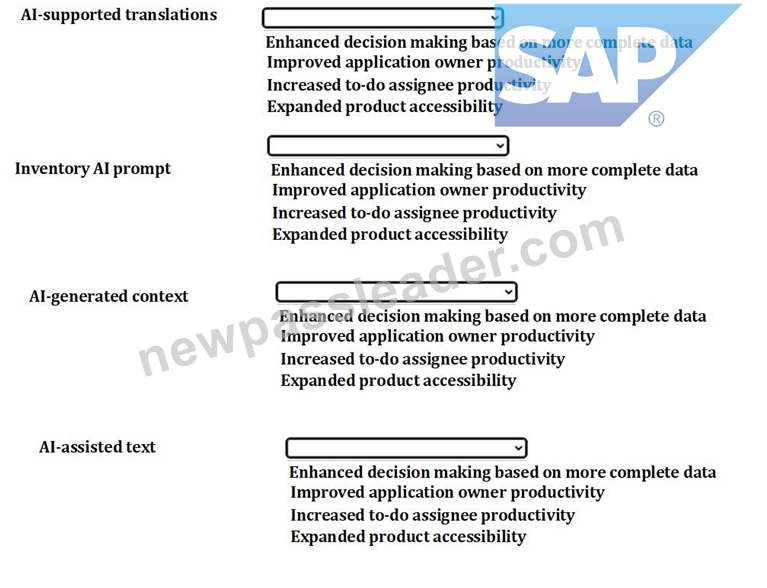
Answer:
Explanation: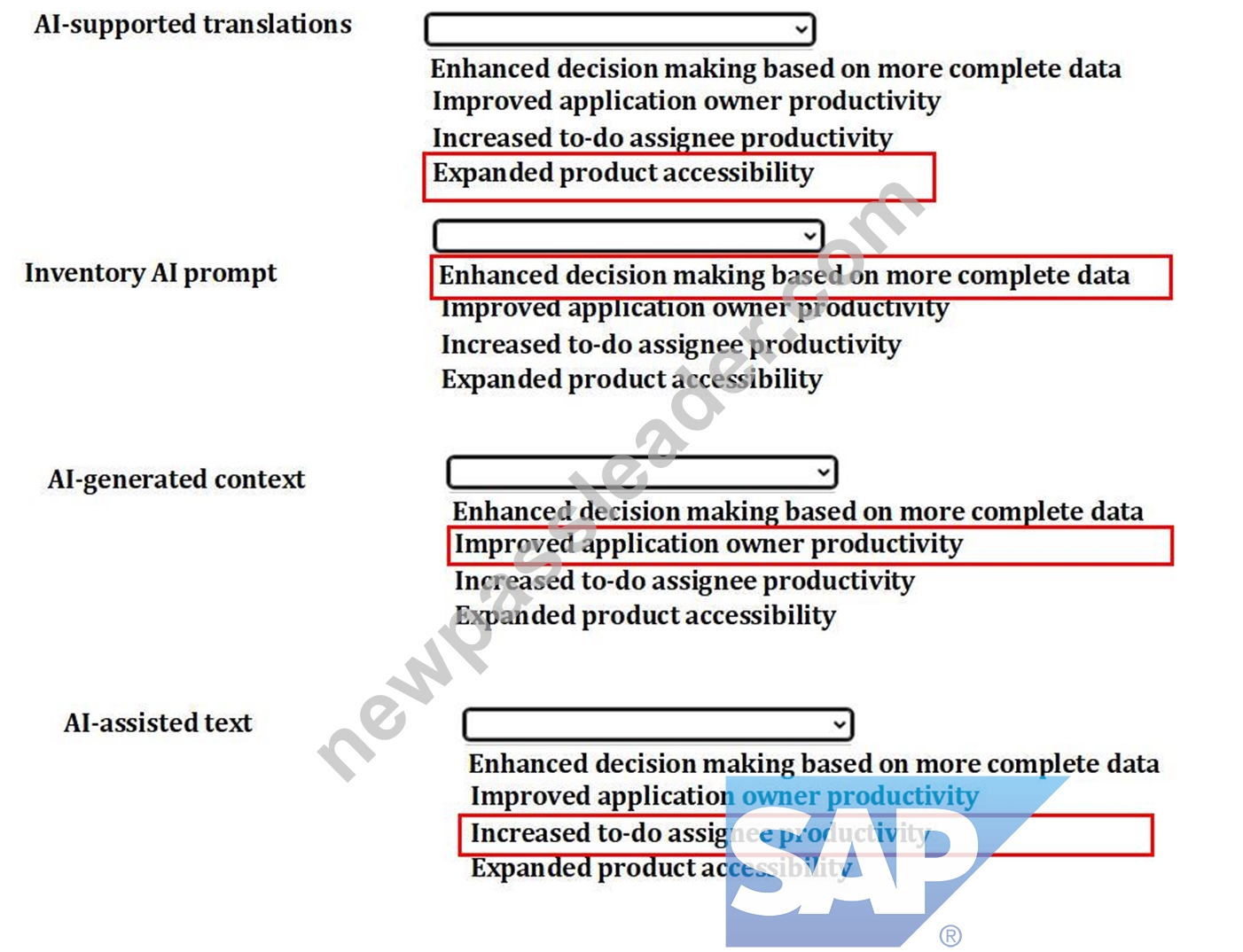
NEW QUESTION # 28
Match the outcomes in the dropdown lists to the capabilities of Joule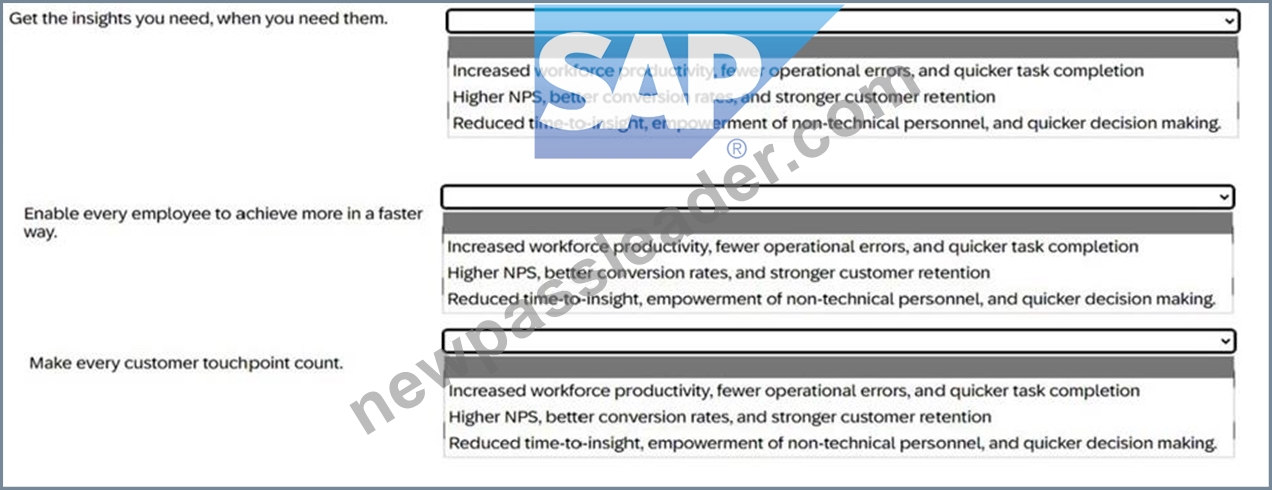
Answer:
Explanation: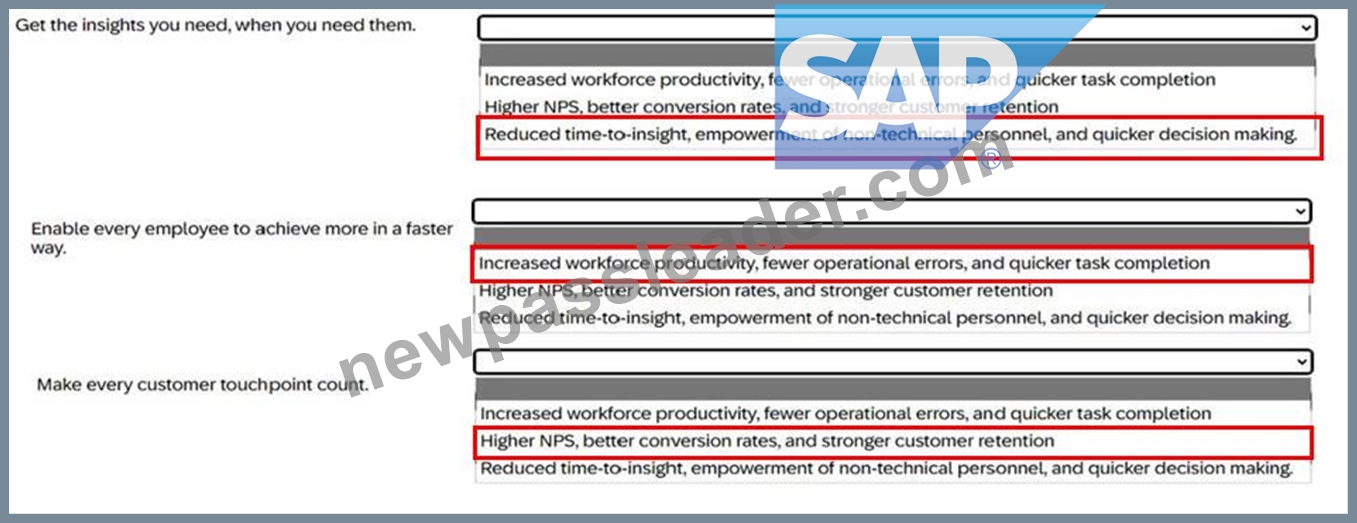
NEW QUESTION # 29
Which component of SAP AI is responsible for automating routine business tasks? Please choose the correct answer.
- A. SAP Conversational AI
- B. SAP AI Core
- C. SAP S/4HANA Cloud
- D. SAP Intelligent RPA
Answer: D
Explanation:
SAP Intelligent RPA is the primary component of SAP AI responsible for automating routinebusiness tasks, combining robotic process automation with AI capabilities. The correct answer is SAP Intelligent RPA, as it is explicitly designed for this purpose.
SAP documentation states: "SAP Intelligent RPA automates repetitive business tasks such as data entry, document processing, and workflow execution by combining robotic process automation with AI capabilities." This solution enables organizations to "streamline routine tasks like invoice processing, order management, and data validation," reducing manual effort and improving efficiency. For example, SAP Intelligent RPA can "extract data from invoices and update financial systems automatically," as seen in SAP S
/4HANA integrations.
The incorrect options are not focused on routine task automation. SAP Conversational AI handles natural language interactions, such as chatbots, not routine tasks. SAP AI Core is an infrastructure platform for AI model development, not task automation. SAP S/4HANA Cloud is a broad ERP system, not a specific automation component. SAP Intelligent RPA's role in automation, as evidenced by its use in SAP Business Technology Platform, confirms its suitability.
NEW QUESTION # 30
......
Positive Aspects of Valid Dumps C_BCBAI_2502 Exam Dumps! : https://www.newpassleader.com/SAP/C_BCBAI_2502-exam-preparation-materials.html
Share Latest C_BCBAI_2502Test Practice Test Questions, Exam Dumps: https://drive.google.com/open?id=1DW0KGInQxcNIAciVrgdmlD1_nMQlUpvy